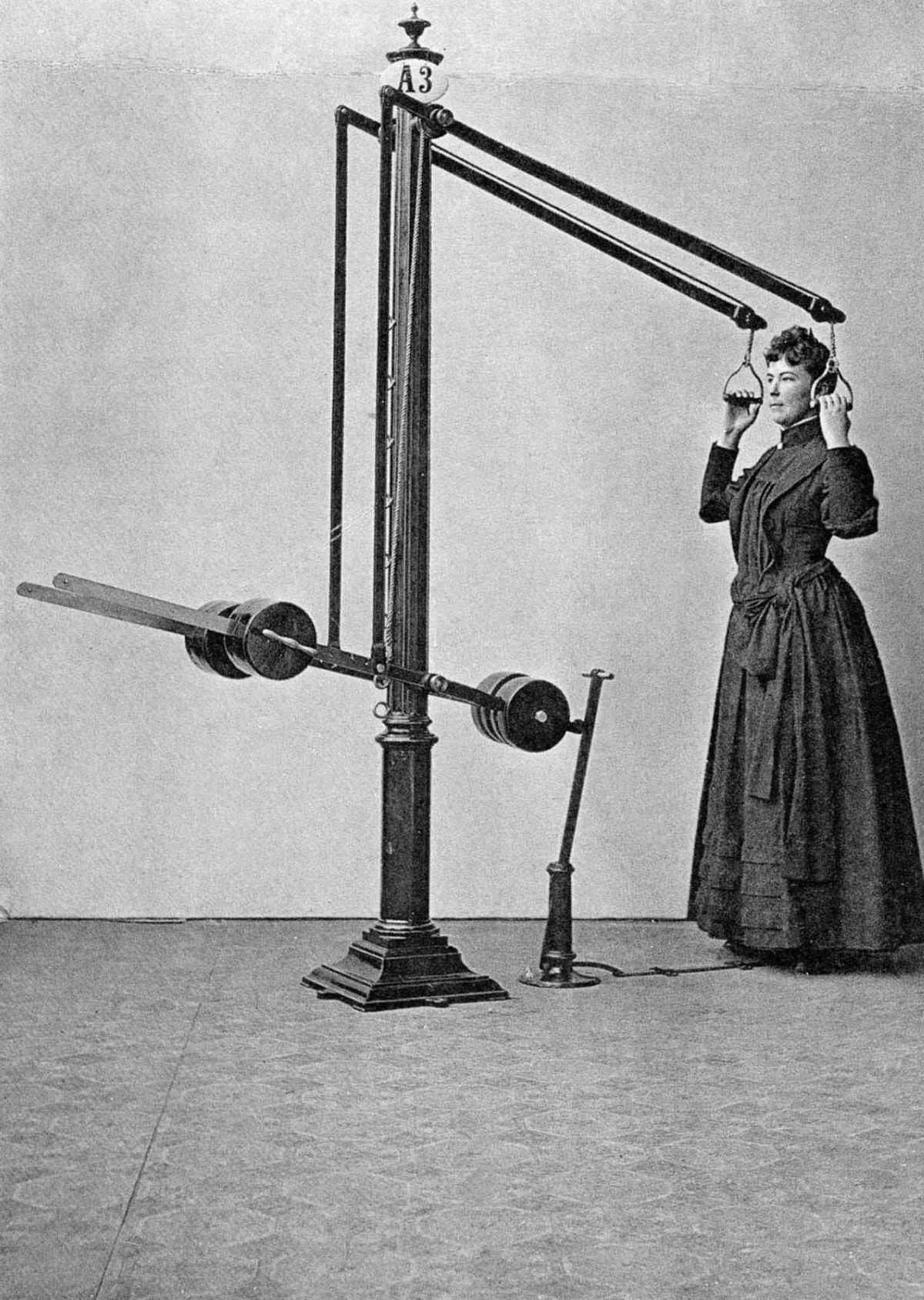
A tall, column-like exercise machine dominates the scene, its long arms extending outward to a pair of suspended hand grips. Standing beside it, a woman in a full-length dress demonstrates the motion with elbows bent and hands raised near her face, as if mid-repetition. The apparatus looks part gym equipment, part workshop contraption, with pulleys, weighted wheels, and rigid levers suggesting a carefully engineered approach to “scientific” fitness.
The title’s promise—an arm-bending apparatus “good for the arms, shoulders, and back”—fits what the mechanism implies: controlled resistance delivered through a guided range of motion. Rather than free weights, the design channels effort through metal joints and counterweights, inviting users to train posture and upper-body strength with measured precision. It’s a striking reminder that the history of exercise equipment is also a history of invention, where biomechanics and marketing met in steel and varnished wood.
What makes this historical photo especially memorable is the contrast between everyday attire and specialized machinery, hinting at a period when physical culture was entering homes, studios, and public halls as modern self-improvement. The stark background keeps attention on the device’s details—its labeled top, the sturdy base, and the mechanical linkage that translates human movement into calculated resistance. For readers interested in early fitness inventions, vintage gym equipment, and the evolution of strength training, this image offers a vivid snapshot of ingenuity in motion.