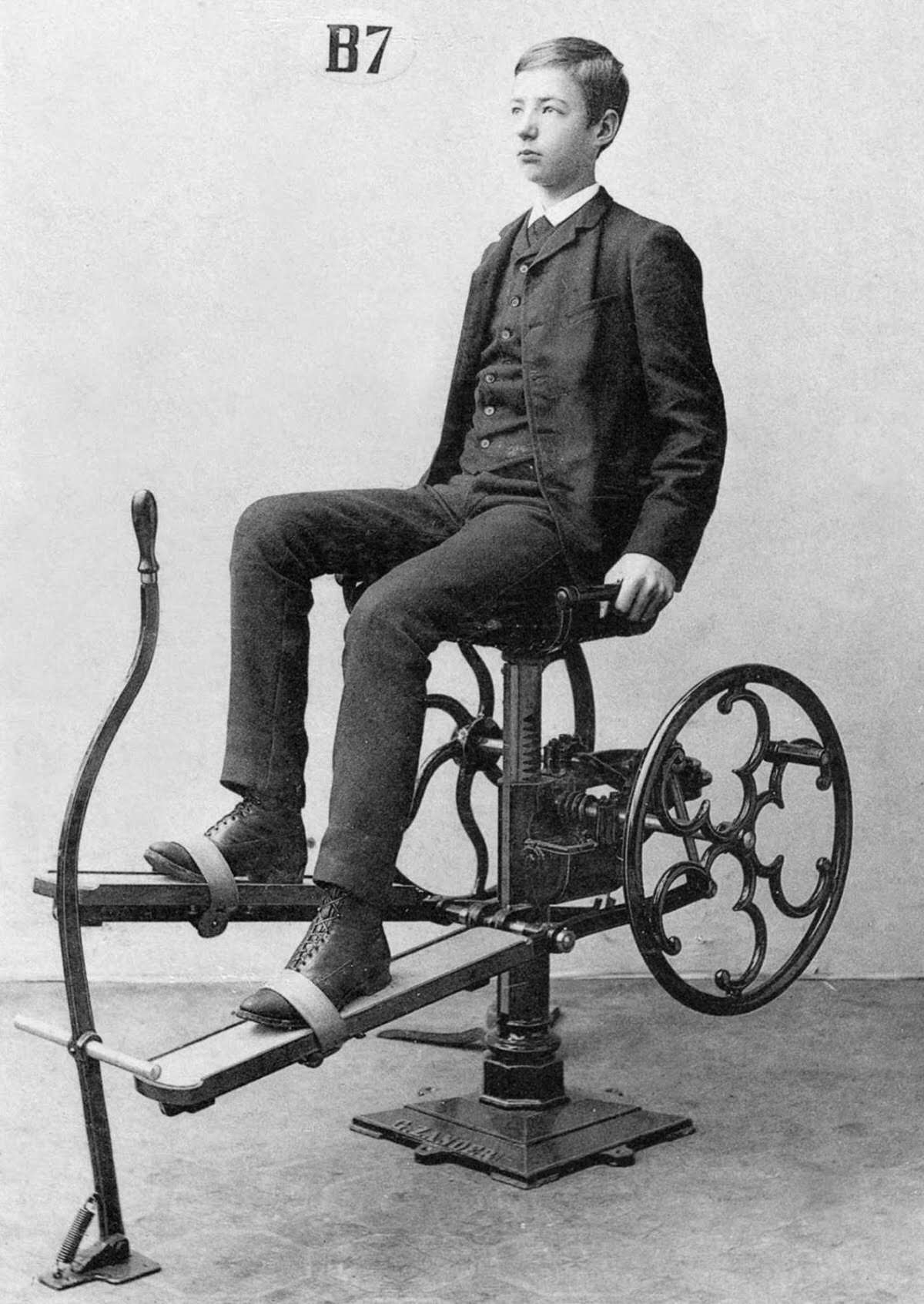
A neatly dressed young man sits upright on a curious contraption labeled “B7,” part bicycle and part stationary machine. His boots are strapped to long footboards, suggesting a stepping motion rather than a simple pedal turn, while a vertical post and saddle keep the rider fixed in place. Off to one side, a large spoked flywheel and linkage hint at the mechanical ambition behind the design, turning human effort into smooth, continuous rotation.
The title, “A velocipede-stepping apparatus,” places this invention in the broader story of early cycling experiments, when inventors tried countless ways to imitate walking, climbing, or marching with machinery. Instead of handlebars and open road, the rider faces a lever-like upright and a spring-tensioned support, as if the machine were meant for practice, demonstration, or controlled exercise. Details in the frame—gears, joints, and the heavy base—emphasize stability and repeatable motion, more workshop device than street vehicle.
Inventions like this reveal an age fascinated by speed, efficiency, and the promise that clever mechanisms could reshape everyday movement. The photograph invites close looking: the restrained posture of the subject, the deliberate foot straps, and the ornate wheel all speak to a period when industrial design and personal mobility were being invented at the same time. For anyone interested in bicycle history, mechanical ingenuity, or the evolution of fitness and training equipment, this velocipede stepping machine offers a striking glimpse of experimentation in progress.