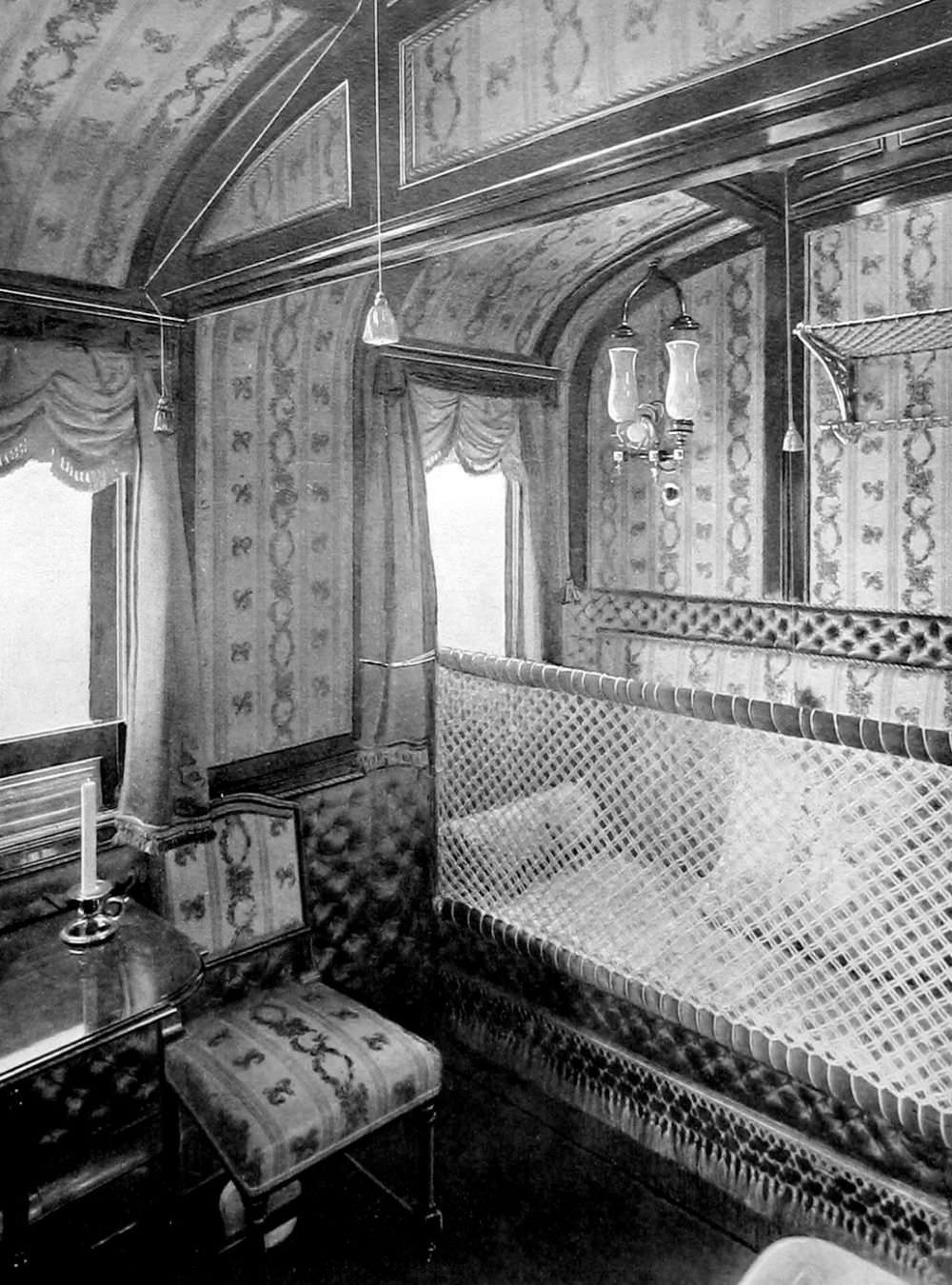
Rich patterned wallpaper, a curved ceiling, and tightly upholstered seating turn this “Interior” into a study of comfort engineered for travel. The room’s narrow proportions and deep window recesses suggest a compartment designed to make limited space feel luxurious, with fabric drapery softening the hard edges of wood trim and paneling. Every surface seems chosen to catch the light and signal refinement, from the trim lines overhead to the repeating motifs along the walls.
In the corner, practical “inventions” sit quietly in plain sight: a wall-mounted lamp with twin glass shades, a small hanging light, and a compact table arranged for convenience. The design balances elegance with utility, hinting at an era when new lighting and fittings were transforming everyday interiors, especially in spaces where self-contained amenities mattered. Even the seating—padded, patterned, and closely fitted—feels like part of a larger system meant to withstand motion and frequent use.
What makes the photograph compelling is how it documents a lived technology of comfort rather than a single machine. Details like the tied-back curtains, the mirrored panel, and the carefully planned corners reveal a mindset that treated interior design as problem-solving: how to illuminate, store, sit, and rest gracefully within a confined footprint. For readers interested in historic interiors, early modern conveniences, and the evolution of design, this image offers a textured glimpse into a world where craftsmanship and innovation shared the same room.