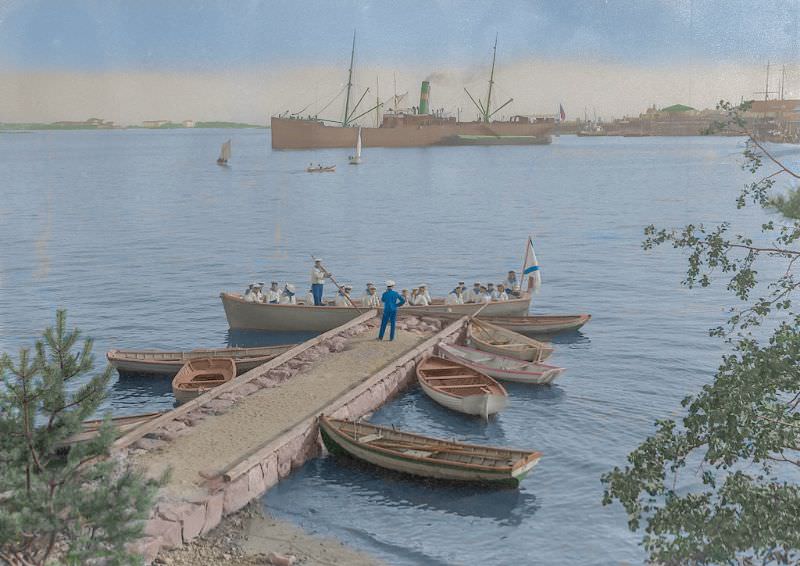
Along a narrow stone jetty, a cluster of Imperial Russian Navy sailors in light uniforms gathers in a small boat, waiting their turn to be ferried back to the larger vessel anchored out in Helsinki’s harbor. The colorization brings out quiet details—a pale summer sky, the blue-gray water, and the warm timber tones of the rowboats pulled close to shore—turning a routine transfer into a vivid waterfront scene. Even without close-up faces, the posture and spacing suggest the practiced order of naval life, where movement is choreographed by tide, timetable, and command.
In the middle distance, the ship sits solid and dark against the open water, its masts and deckline emphasizing the scale difference between ocean-going craft and the humble boats shuttling men and gear. A flag flickers at the stern, and scattered sailboats dot the bay, hinting at a working port that also made room for leisure and local traffic. Helsinki’s shoreline remains understated here, more suggestion than skyline, letting the harbor itself—its crossings, moorings, and small craft—carry the story.
Set in the 1920s, the moment resonates as more than a simple “return to ship,” because it sits in a decade of shifting borders and identities around the Baltic Sea. The title’s pairing of Imperial Russian Navy sailors with Helsinki invites reflection on how uniforms, institutions, and empires linger in photographs even as the world around them changes. For readers drawn to naval history, early 20th-century Finland, or expertly restored color historical photos, this image offers a textured glimpse of everyday maritime routine at the edge of a turbulent era.