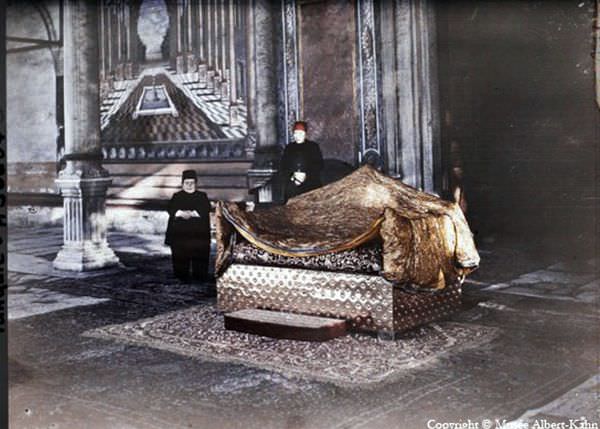
Muted colorization lends an almost tactile presence to an Ottoman-era interior, where a draped sarcophagus-like tomb sits on a patterned base and rug. The covering—richly textured and edged with trim—draws the eye first, while carved stone, tiled surfaces, and a long corridor of repeating arches recede into shadow behind it. The composition frames the monument as both sacred object and centerpiece, emphasizing quiet symmetry and depth.
Two solemn figures in dark clothing stand near the tomb, their stillness reinforcing the sense of reverence inside this shrine-like space. Light falls softly across the floor and columns, hinting at the age and wear of a well-visited site without giving away a precise city or building. Details such as the geometric floor patterns and layered architectural ornament speak to Turkey’s early-1900s crossroads of tradition, faith, and daily life.
For readers interested in Turkish history, Ottoman architecture, and early travel photography, this colorized scene offers a compelling doorway into the period. It invites close viewing: the textiles, the masonry, and the measured perspective all suggest how memory was curated in monumental places. As a WordPress feature image, it pairs naturally with topics like mausoleums and türbe culture, heritage preservation, and the visual language of sacred spaces in Turkey during the 1900s.