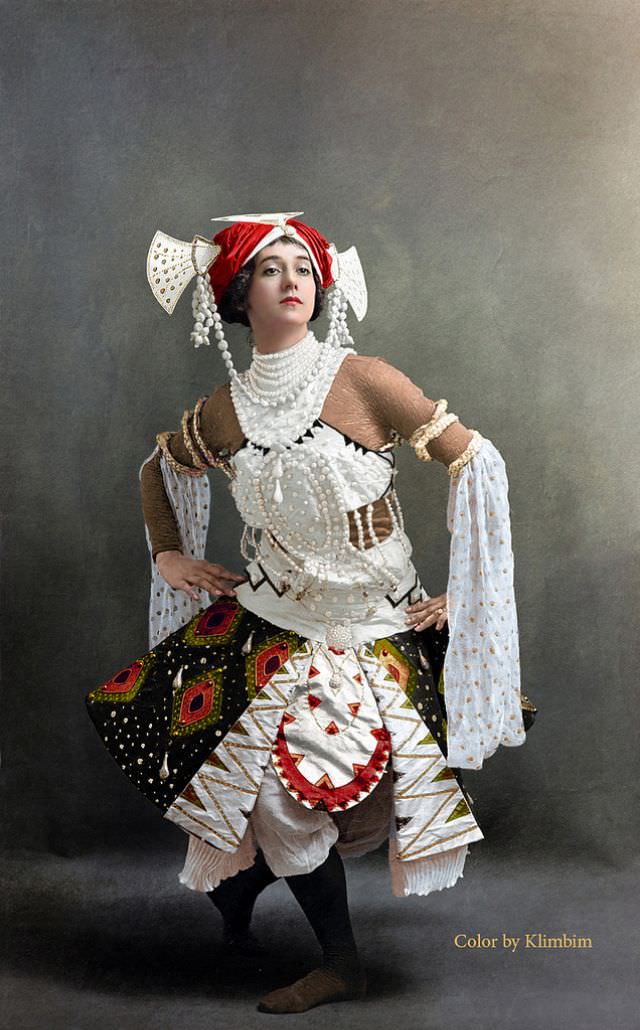
Tamara Karsavina poses with a dancer’s poise and a character’s confidence, embodying the Fiancée from *The Blue God* in 1912. The colorization draws the eye to her bright red head covering and the crisp white of layered beadwork, while her lifted chin and hands-on-hips stance suggest a moment held between ceremony and performance. Against a plain studio backdrop, every detail of costume and posture becomes the narrative.
Costume design takes center stage here: strings of pearls cascade across the bodice, gauzy drapes fall from the arms, and the structured skirt blooms outward with bold geometric panels and jewel-like accents. The palette—creamy whites, deep blacks, and flashes of red and gold—reads as theatrical from a distance, yet up close it feels meticulously assembled for movement under stage lights. Even the symmetrical headpiece frames her face like an emblem, turning portraiture into pageantry.
For readers exploring early 20th-century ballet history, Ballets Russes-era stage fashion, or the art of photo colorization, this portrait offers a vivid entry point. It preserves not only a performer in role, but also the visual language of theatrical exotica that shaped so much stage imagery of the period. As a historical photo brought to life with color, it invites a longer look at how dance, costume, and studio photography collaborated to build enduring icons.