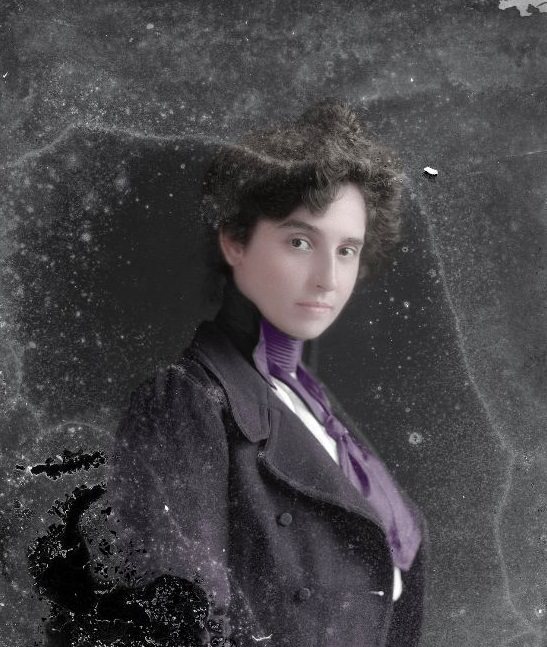
A steady, direct gaze meets the viewer in this colorized portrait of an unidentified woman, rendered with soft tones that bring a once-faded print back toward life. Her dark, tailored coat and high, structured collar suggest careful dressing and a sense of modern confidence for her era, while the simple studio backdrop keeps attention fixed on her face. Even without a caption or family inscription, the image carries the intimate feeling of a formal sitting meant to be kept, shared, and remembered.
Details in the styling invite close reading: a neatly arranged updo, a crisp neckline, and a hint of purple at the throat that the colorization gently emphasizes. The pose is composed rather than stiff, with the shoulders angled and the head slightly turned, creating a portrait that feels both deliberate and personal. Marks of age—speckling, abrasions, and surface wear—remain visible, reminding us that the photograph itself has traveled through time as much as its subject has.
For anyone researching historical portraits, women’s fashion, or the craft of photo restoration, this post offers a vivid example of how colorization can restore presence without erasing patina. The lack of identification is part of its story: an anonymous sitter whose individuality survives in expression, clothing, and posture, even when her name does not. If this face looks familiar or the attire hints at a particular community or period you recognize, readers are invited to share insights that might help place her back into history.