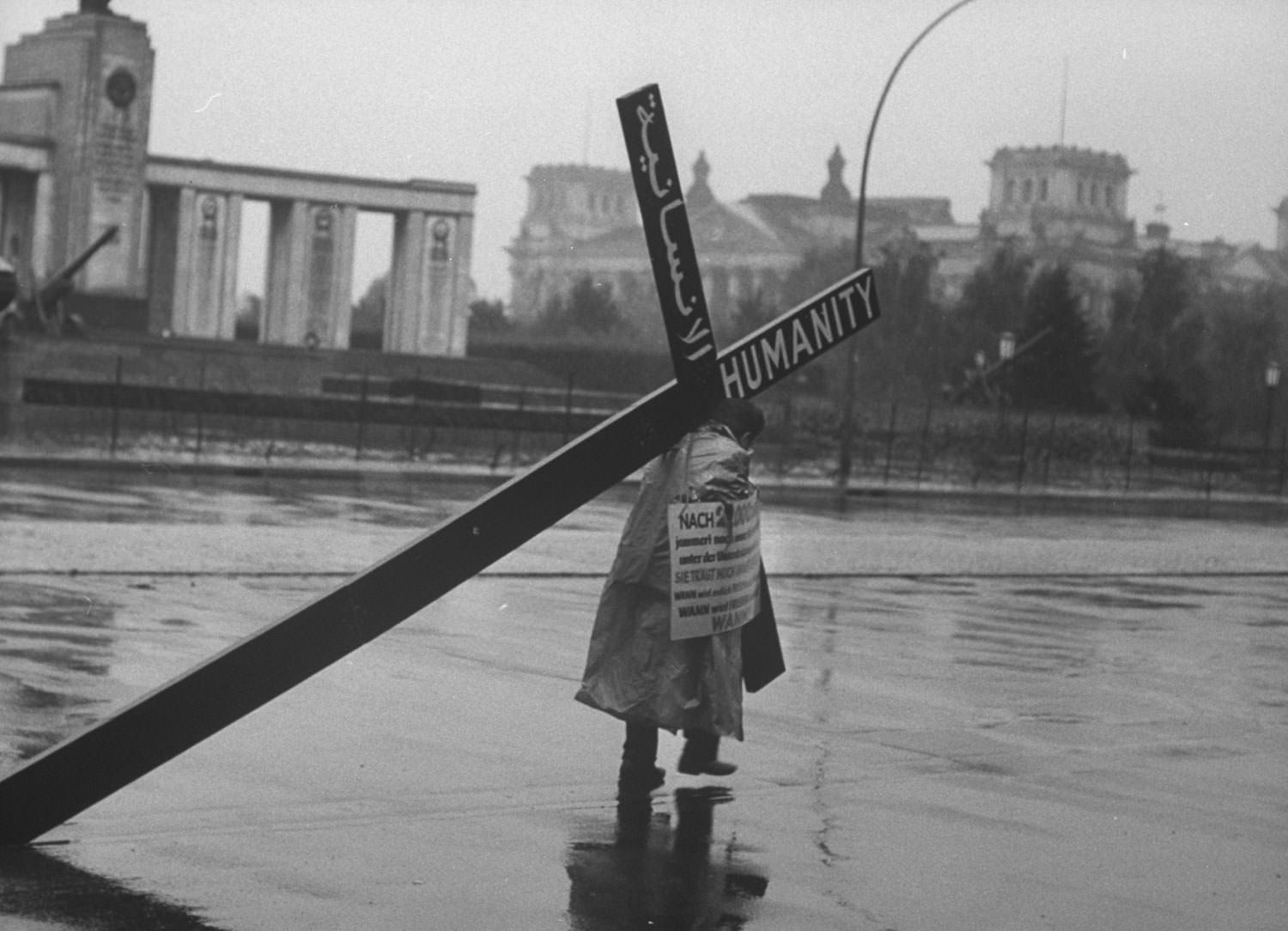
Rain-dark pavement and an empty sweep of street set the stage as Lebanese businessman Edmond Khayat shoulders an 85‑pound wooden cross in October 1961, turning a solitary walk into a stark protest against the Berlin Wall. The cross dominates the frame, angled like a burden and a warning, with the word “HUMANITY” clearly painted across one arm. In the distance, monumental buildings and broad avenues recede into haze, reinforcing the sense of a city made vast and impersonal by Cold War division.
Khayat’s gesture reads like a public act of conscience rather than a rally, more pilgrimage than parade. A placard pinned to his coat suggests a message meant for passersby, while the cross itself carries multiple scripts, hinting at an appeal that reaches beyond one language or one nation. That mix of symbolism—religious weight, civic protest, and international address—captures the moral vocabulary many people used to speak about borders, walls, and the cost of political rupture.
Seen today, the photograph resonates as a reminder that the Berlin Wall provoked not only statecraft and headlines but also personal, highly visible forms of dissent. The stark composition—one figure, one heavy cross, and a city backdrop—makes the protest feel both intimate and universal, connecting individual agency to a global crisis. For readers searching Cold War history, Berlin Wall protests, or the human stories behind divided cities, Khayat’s march offers a compelling, unforgettable fragment of 1961.