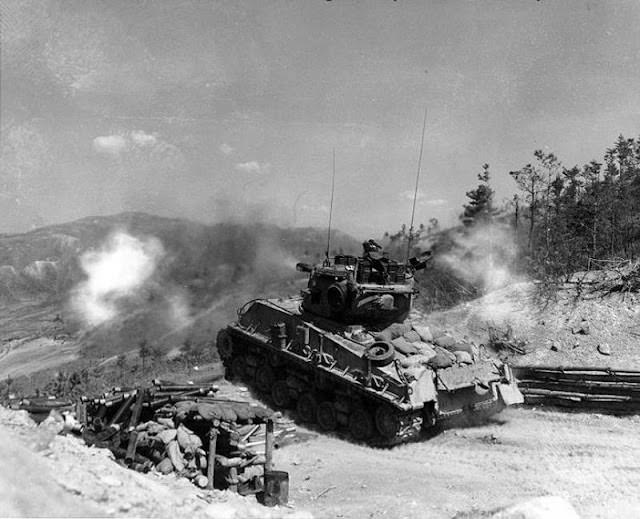
Dust and cordite hang over a rough mountain road as a Sherman tank bucks against recoil, its 76 mm gun flashing toward distant bunkers. The armored vehicle sits angled on the slope, tracks gripping loose earth and rock while a crewman rides high near the turret, scanning the hillside. In the background, smoke blossoms along the ridgeline, hinting at a hard, methodical exchange where visibility and terrain mattered as much as firepower.
Dated 1952 in the title, the scene speaks to the grinding character of the Korean War’s mid-phase, when fortified positions and entrenched lines often turned advances into artillery-and-armor duels. The reference to KPA bunkers underscores the defensive networks tanks were tasked to crack—earth-and-timber strongpoints designed to survive shelling and command approaches. Here, the Sherman’s 76 mm gun is the story’s centerpiece: a weapon valued for its improved punch, paired with the tank’s mobility to bring direct fire onto stubborn targets.
Looking closely, the photograph is as much about environment as machinery—switchback roads, bare slopes, and scattered debris framing the tank like a stage set for attritional warfare. It’s an arresting reminder of how crews operated on exposed ground, balancing speed, cover, and coordination with infantry against concealed firing points. For readers searching Korean War armor, Sherman tank combat, or 76 mm gun action against bunkers, this image distills the era’s stark, practical violence into one frozen moment.