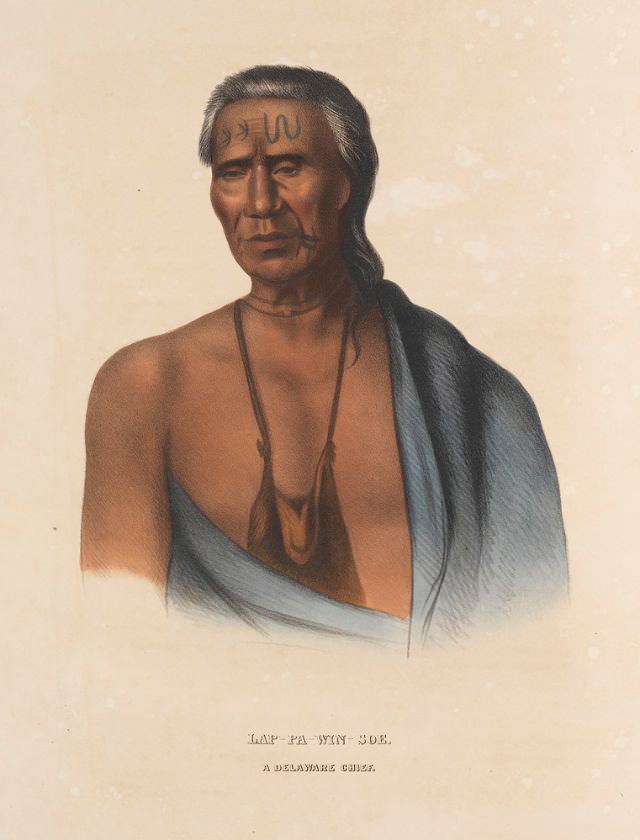
Lap-Pa-Win-Soe faces the viewer with a steady, unsmiling calm that gives this portrait its power. The artist renders him from the chest up, bare-shouldered and draped in a dark robe, with a simple cord and pendant hanging at the center of his chest. Fine facial markings and a small painted motif on the forehead draw the eye, while the softly blended background keeps attention fixed on his expression.
As an artwork titled “Lap-Pa-Win-Soe, A Delaware Chief,” the piece belongs to a tradition of illustrated Native American portraiture that sought to present leaders as distinct individuals rather than anonymous types. Subtle choices—his direct gaze, the controlled posture, the careful modeling of skin and hair—suggest dignity and authority without relying on elaborate props. Even without additional caption details, the composition communicates a public presence: someone meant to be recognized and remembered.
Collectors and researchers interested in Delaware history, Indigenous leadership, and early portrait prints will find this image especially compelling. The visible title text beneath the figure anchors the identification, while the hand-colored look highlights the period style of printed illustration. Ideal for a WordPress post on historical art and Native American portraits, it invites readers to linger over what is shown—and to consider what stories were left outside the frame.