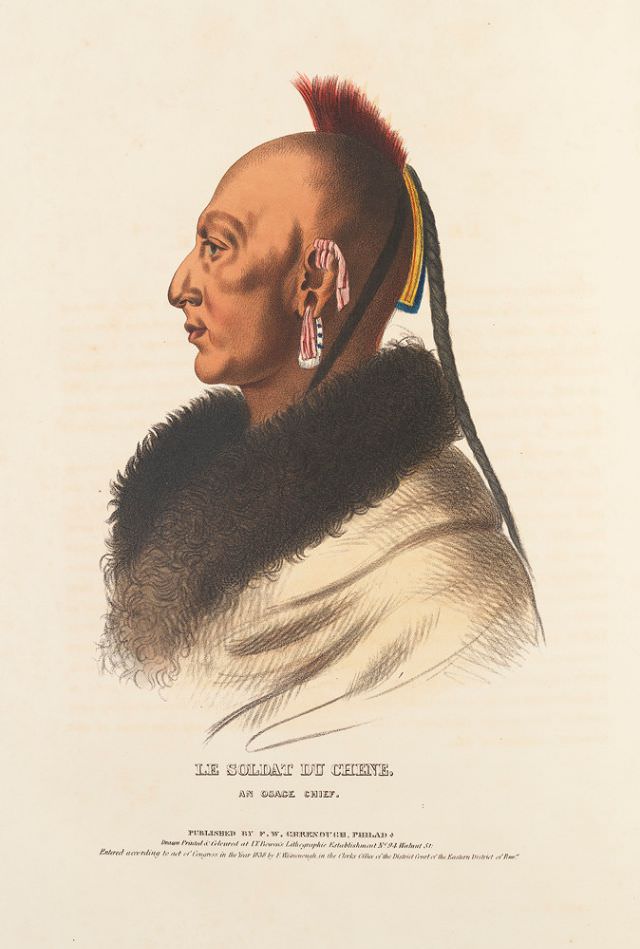
Rendered in careful profile, “La Soldat Du Chene” presents an Osage chief with a steady gaze and a commanding presence, the kind of portrait that asks the viewer to slow down and observe. The artist emphasizes the strong line of the nose and jaw, while a bright red crest of hair rises above a closely shorn scalp, guiding the eye toward the face. Below, a thick fur collar frames the shoulders, adding texture and weight to the composition and reinforcing the dignity of the sitter.
Details of adornment carry much of the story: a long braid falls behind the head, bound with a ribbon-like band, and the ear is dressed with a dangling ornament that introduces delicate pattern against the warm tones of skin. The restrained background leaves no distraction, turning the portrait into a study of identity and status rather than scenery. As an artwork, it blends documentary intent with the stylized choices common to published prints of Indigenous leaders, balancing realism with the period’s visual conventions.
At the bottom of the print, the French title and the English line “An Osage Chief” signal how the image was meant to travel across languages and audiences, circulating as both art and ethnographic curiosity. For readers searching for Osage history, Native American portrait prints, or early illustrated depictions of Indigenous leadership, this piece offers a striking entry point. It remains a compelling reminder that even a single profile—carefully colored, meticulously presented—can carry layered meanings about representation, respect, and the ways cultures were recorded on paper.