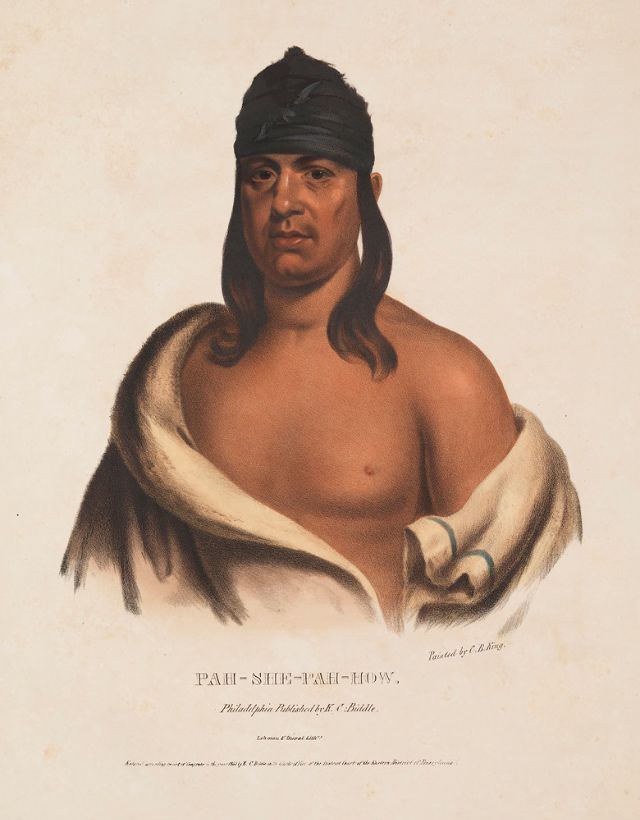
Pah-She-Pah-How meets the viewer with a steady, unflinching gaze, set against an open, uncluttered background that keeps every detail focused on the sitter. A dark headwrap frames long hair that falls to the shoulders, while a fur-draped garment slips loosely around the upper body, rendered with soft shading that emphasizes texture and weight. The careful modeling of the face—broad planes, warm tones, and subtle highlights—suggests an artist intent on presence and individuality rather than decoration.
At the bottom of the plate, the printed title anchors the portrait as a named likeness, and the surrounding negative space gives the composition a formal, museum-like stillness. The style reads like a hand-colored print or painted plate: crisp outlines, restrained palette, and a balance between realism and idealized finish typical of historical portrait publishing. Even without a detailed setting, the work conveys status through pose and presentation, turning clothing, hair, and expression into the primary narrative.
For readers interested in Indigenous portraiture, early American art, and the history of printed “artworks” made for circulation, this piece offers a compelling study in how identity was recorded and mediated on paper. The simplicity of the background invites close looking—at the fur’s edge, the folds of fabric, and the quiet authority in the sitter’s expression—while the title “Pah-She-Pah-How” encourages further exploration of the context behind the name. As a WordPress post feature image, it brings both visual impact and searchable relevance for those tracing historic portraits, archival prints, and cultural representation in art.