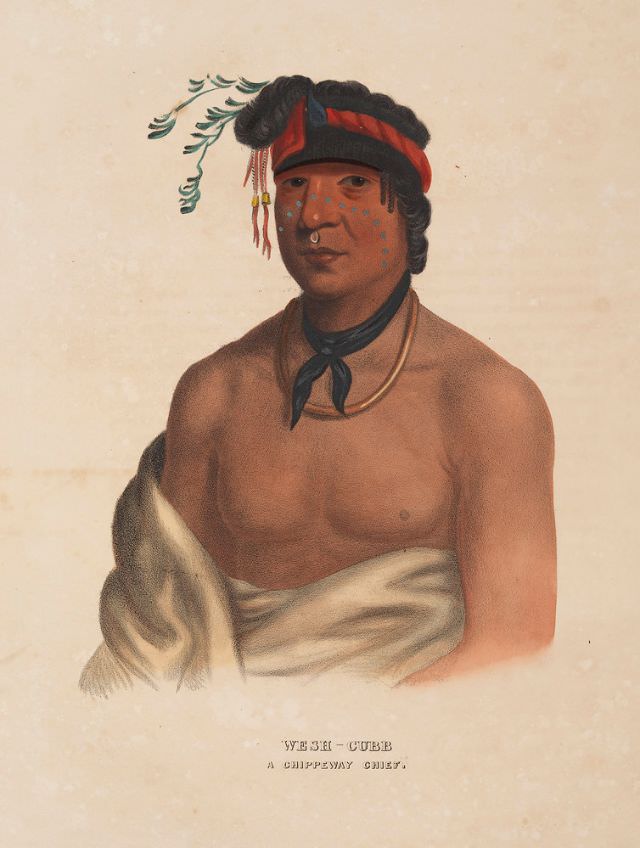
Wesh-Cubb is presented in a formal painted portrait that emphasizes dignity over drama, with a calm, direct gaze and an upright posture. The artist’s careful color work draws attention to distinctive details: a dark headband marked with a bold red stripe, braided hair, and a small cluster of feathers and ornaments that adds movement against the otherwise spare background. Light face paint—applied in dotted patterns—and a nose ring become visual focal points, inviting the viewer to linger over the intentionality of adornment.
The minimal setting is part of the story, too, keeping the eye on clothing and personal regalia rather than on a staged landscape. A simple neck scarf and a pale wrap across the torso are rendered with soft shading, giving the figure weight and presence while leaving room for interpretation. Beneath the portrait, the printed caption “Wesh-Cubb, a Chippeway Chief” frames the image as both artwork and record, reflecting a time when Indigenous leaders were frequently documented through the lens of outsiders’ collecting and publishing.
For readers searching for Native American history images, Chippeway (Ojibwe/Chippewa) portraits, or early American artworks, this piece offers a striking example of how identity was communicated through paint, pattern, and posture. It can be read as a meeting point between representation and reality: what the sitter chose—or was encouraged—to display, and what the artist chose to emphasize for an audience beyond the community. As an “Artworks” post, it serves well for anyone exploring historical illustration, Indigenous portraiture, and the visual language of leadership.