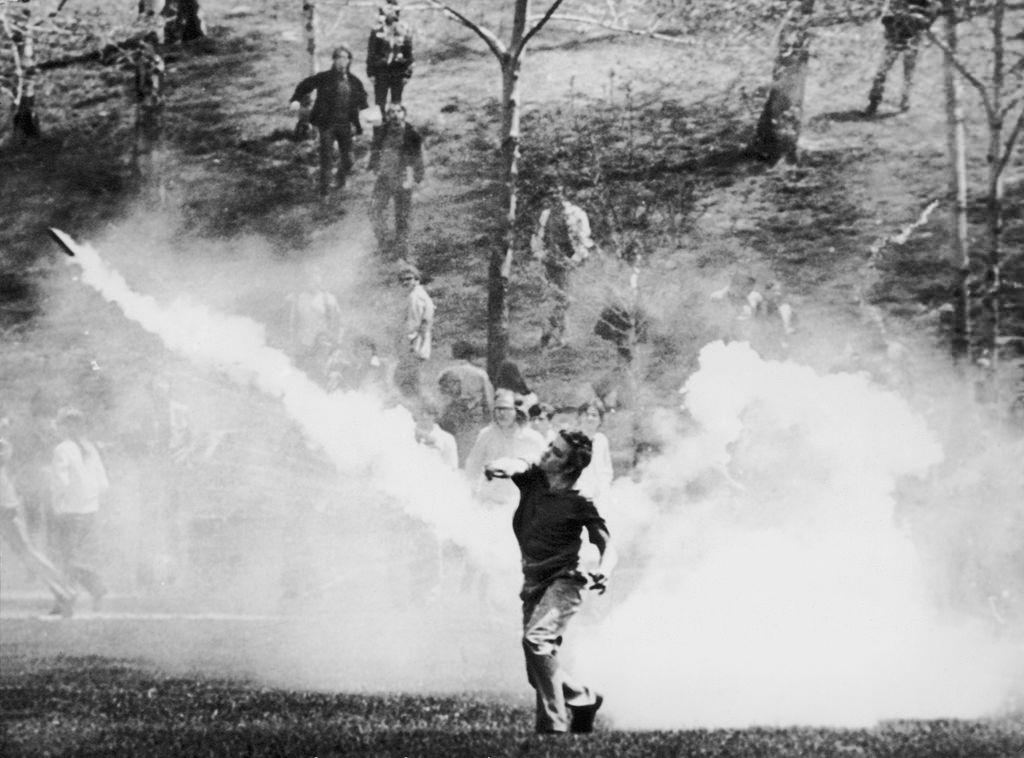
Mid-throw, a lone student cuts through a low, rolling cloud of tear gas, arm cocked and body twisting as if the whole scene has narrowed to a single urgent gesture. Around him, scattered figures drift at the edges of the haze, some retreating, some pausing, all partially swallowed by the smoke that blurs the campus-like lawn and bare trees behind. The canister’s pale plume hangs in the air, turning the open space into a contested corridor where visibility—and control—disappears.
May 4, 1970 sits at the heart of America’s Vietnam War era unrest, when demonstrations over the conflict and government authority erupted on university grounds and in city streets alike. The presence of National Guardsmen, implied by the title, underscores how quickly protest could meet military-style response, with tear gas deployed to disperse crowds and reassert order. That act of throwing the canister back crystallizes the volatile push-and-pull of the moment: resistance answered by escalation, and escalation met again by defiance.
For readers searching the history of Vietnam War protests, student activism, and the National Guard’s role in domestic unrest, this photograph offers a stark, physical record rather than an abstract argument. It preserves the sensory reality—smoke, movement, panic, adrenaline—that written accounts often struggle to convey, while leaving faces and affiliations indistinct in the fog of events. Seen today, the image remains a reminder of how quickly civic conflict can transform ordinary ground into a battlefield of symbols, tactics, and consequence.