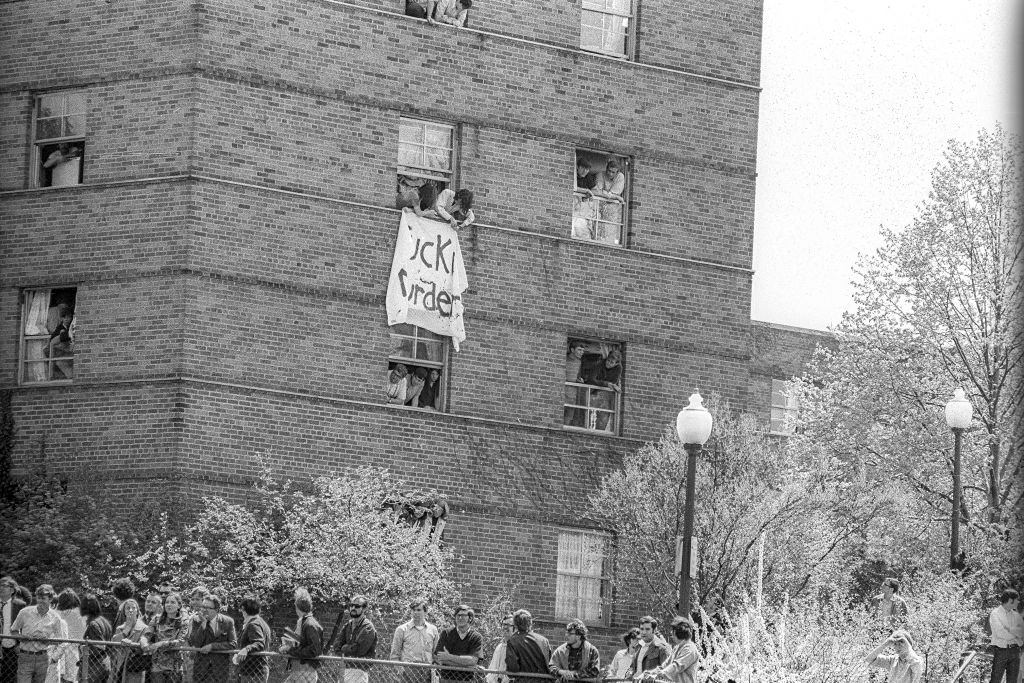
A brick dormitory becomes a bulletin board of dissent in Kent, Ohio, as students lean out of open windows to unfurl a handmade banner during an antiwar protest on May 4, 1970. Faces gather in multiple panes, some watching from above while others press close to the message, turning ordinary campus architecture into a stage. Below, a line of onlookers clusters along a fence, their attention pulled upward toward the cloth sign and the commotion it signals.
The banner’s rough lettering and improvised fabric carry the hallmarks of student protest culture at the height of Vietnam War opposition, when urgency mattered more than polish. This scene captures how quickly a dorm could shift from private residence to public forum—windows becoming speaking points, and the building’s façade serving as a backdrop for collective argument. Even without close-up expressions, the body language—leaning, pointing, pausing—suggests a campus holding its breath.
For readers searching the history of the Kent State protest, antiwar demonstrations, and the broader U.S. home-front response to Vietnam, the image offers a grounded view of what mobilization looked like in real time. It emphasizes the everyday setting—brick walls, spring trees, campus lampposts—against which national crisis played out among students and bystanders. In that contrast lies the photograph’s power: political conflict rendered in the plain geometry of dorm windows and a banner made to be seen.