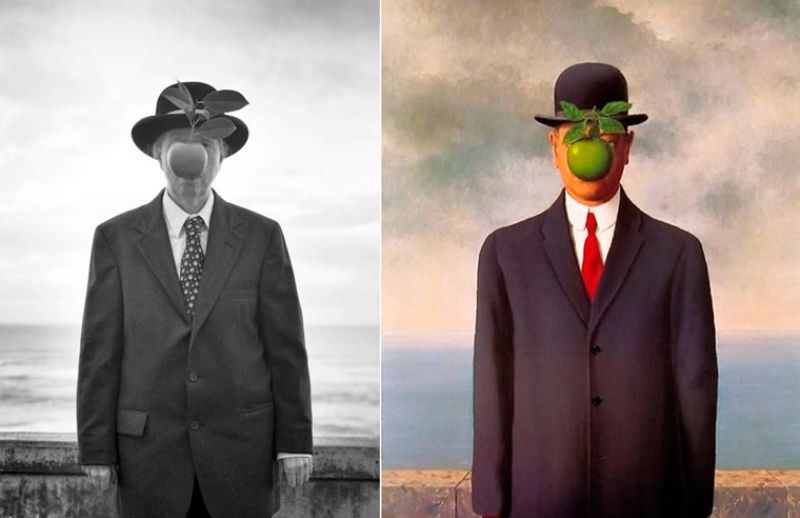
Few artworks in Surrealism feel as instantly familiar—and as stubbornly mysterious—as René Magritte’s “The Son of Man.” A formally dressed figure stands front-facing in a dark overcoat and bowler hat, poised against an open sky and a low stone barrier that hints at a waterfront beyond. The composure is almost ordinary, yet the scene refuses to settle into portraiture, inviting viewers to linger on what is withheld as much as what is shown.
At the center of the puzzle floats a bright green apple, blocking the man’s face while its leaves brush the brim of the hat. That simple obstruction turns identity into a riddle: the body is present, the stance is confident, but the individual remains unknowable. Magritte’s clean lines and calm atmosphere make the disruption feel deliberate rather than chaotic, one of the reasons this painting has become a defining image of Magritte art and classic surrealist imagery.
Alongside the finished color version, the contrasting monochrome study shown here highlights the artist’s interest in structure, silhouette, and the balance between realism and illusion. The understated background—clouded sky, distant horizon, and restrained architectural edge—keeps attention on the paradox of concealment in plain sight. Whether you’re searching for René Magritte “The Son of Man” analysis, surrealist painting references, or iconic bowler hat symbolism, this work remains a striking gateway into Magritte’s enduring questions about seeing and knowing.