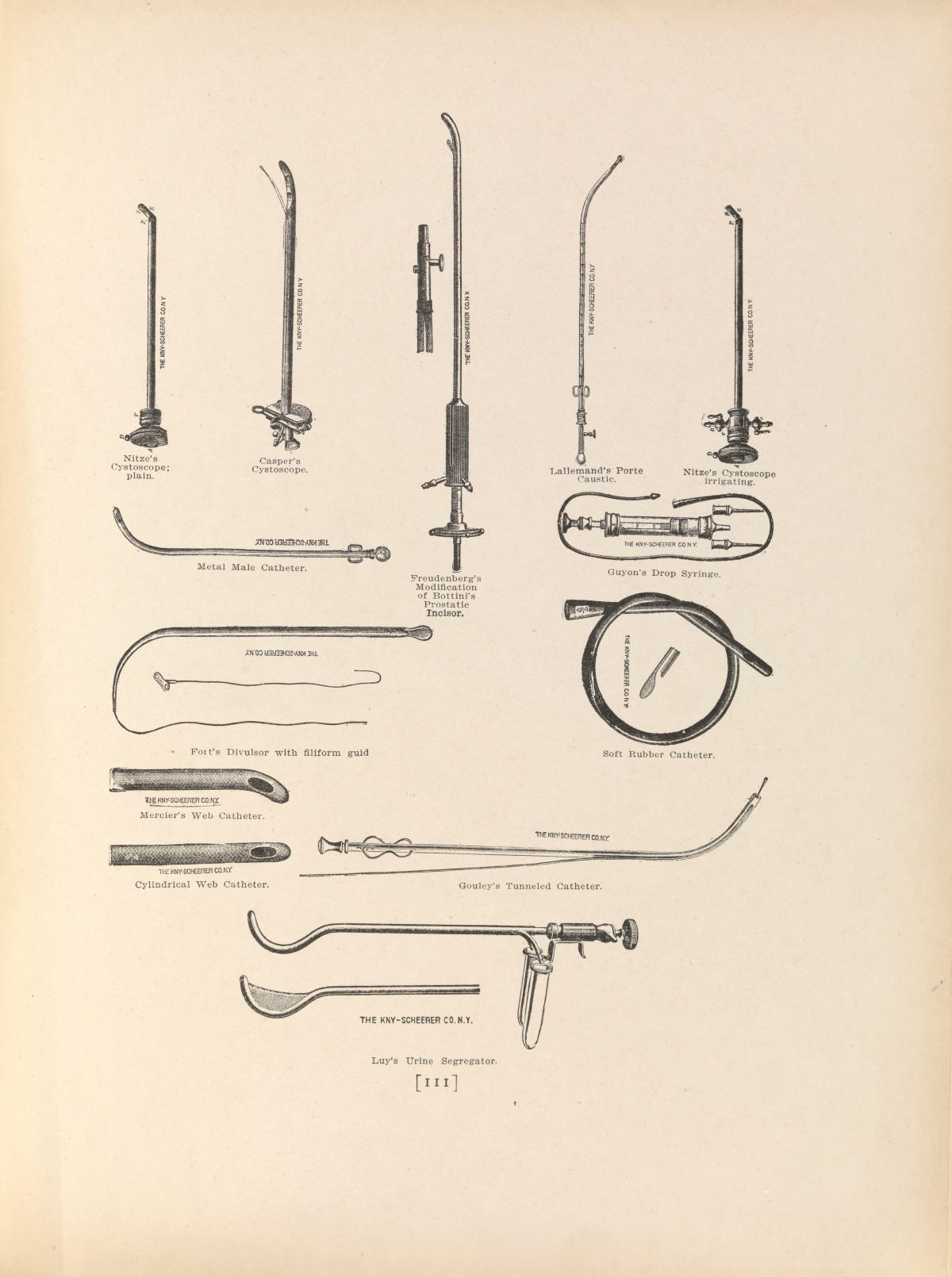
Plate XXXIV lays out a careful inventory of surgical instruments associated with external urethrotomy and prostatectomy, presented with the crisp, instructional clarity of a medical atlas. Long, slender shafts, curved tips, and adjustable fittings are arranged across the page like a technician’s toolkit, each form drawn to emphasize function over flourish. The overall effect is both clinical and strangely elegant—an artwork of necessity, where precision becomes its own aesthetic.
Readable labels identify specialized devices such as Nitze’s cystoscope (shown in “plain” and “irrigating” forms), Casper’s cystoscope, Lallemand’s porte caustic, and Guyon’s drop syringe, hinting at the wide range of inspection, irrigation, and treatment methods used in urologic practice. Several catheter designs appear side by side—metal, soft rubber, tunneled, and “web” varieties—illustrating how surgeons relied on subtle differences in shape and flexibility to navigate delicate anatomy. Manufacturer marks printed along the instruments underscore the era’s growing medical instrument industry and the standardization that followed.
For readers interested in the history of surgery, urology, and medical illustration, this plate offers a grounded look at the tools behind procedures that were often life-altering for patients. The page invites close inspection: screw mechanisms, valves, and graduated curves reveal the ingenuity—and limitations—of earlier operative technique. As a WordPress feature, it serves equally well as a historical reference and as a striking piece of scientific visual culture tied to prostate surgery and urethral instrumentation.