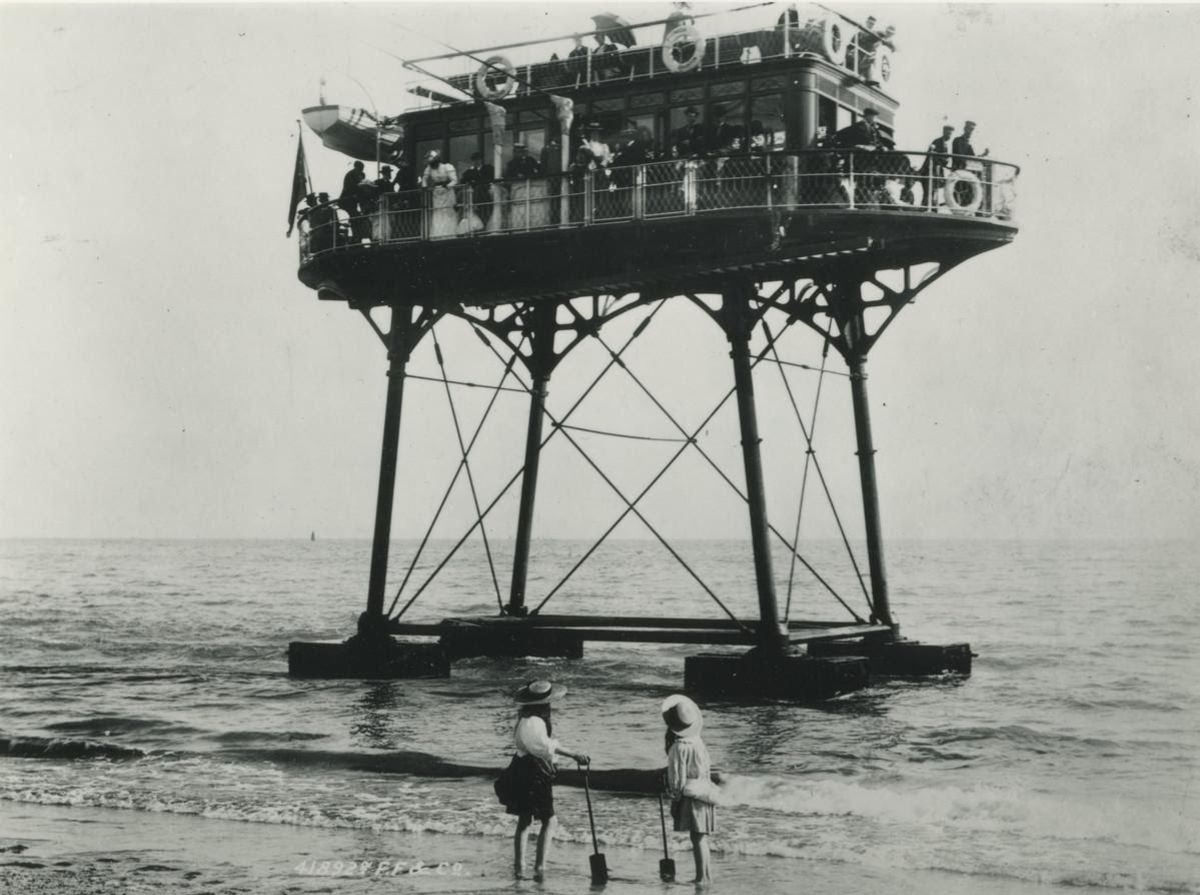
Balanced above the surf on spindly steel legs, Brighton’s “Daddy Long-Legs” looks less like a train and more like a floating pier that decided to go for a walk. The car sits high over the water with railings, lifebuoys, and a crowd of curious passengers peering out from the sides and upper deck, while the open sea stretches behind it. Even from the shoreline, the scale feels startling—an elevated platform rolling where waves normally rule.
In the foreground, two beachgoers with buckets and hats pause to watch this odd seaside electric railway pass by, turning an everyday day at the shore into a scene of invention and spectacle. The contrast is irresistible: leisure at the water’s edge set against an experimental machine built to travel over the tideline. Details like the cross-braced supports and the long undercarriage emphasize why the nickname stuck, evoking an ungainly but purposeful creature striding across the shallows.
Stories of late-19th-century engineering rarely get a more dramatic backdrop than the English Channel, and this historic photo captures the era’s confidence in new transport ideas. For readers interested in Brighton history, Victorian and Edwardian seaside culture, and unusual railways, the Daddy Long-Legs Railway stands out as a genuine “how did that work?” moment—part attraction, part transit, and entirely unforgettable. It’s a reminder that progress wasn’t always streamlined; sometimes it arrived on legs.