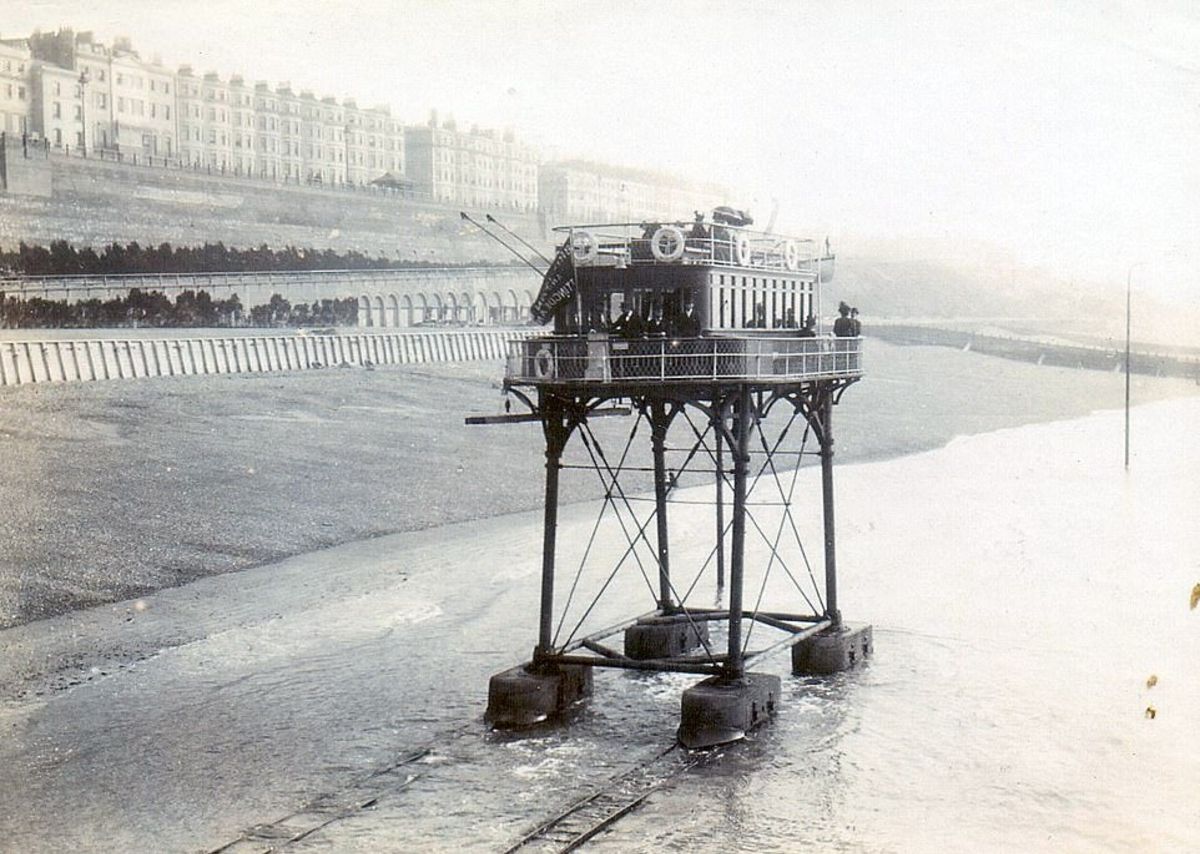
Rising on spindly legs above the wet, rippled sand, the Daddy Long-Legs Railway looks more like a seaside contraption from a dream than a piece of transport history. The passenger cabin sits high and boxy, ringed with railings and life buoys, while the tall framework beneath it strides over the shoreline. Behind, the long sweep of Brighton’s seafront buildings and the protective sea wall give a sense of scale that makes the machine seem even stranger—half tram, half pier, and entirely unconventional.
The tracks are visible at low tide, running straight across the beach where waves can reclaim them at any moment, and the vehicle’s wide footings hint at the challenge of moving through shifting sand and shallow water. Details like the open viewing platform and the enclosed windows suggest it wasn’t only about getting from A to B; it was also an attraction, offering passengers an elevated ride with sea air and spectacle. Even in a still photograph, the scene implies motion: a slow, deliberate progression along the coast, balanced on metal stilts as if walking the edge of land and sea.
For anyone interested in Victorian and early electric transport experiments, this image captures the boldness of seaside engineering in the 1890s without needing exaggeration. Brighton’s “weird but interesting” electric train stands as a reminder that innovation often arrives in odd shapes, especially when inventors try to solve local problems—tides, tourism, and the lure of novelty—at the same time. It’s a perfect snapshot of historical invention culture: practical ambition dressed in showmanship, poised against the vast, bright emptiness of the shore.