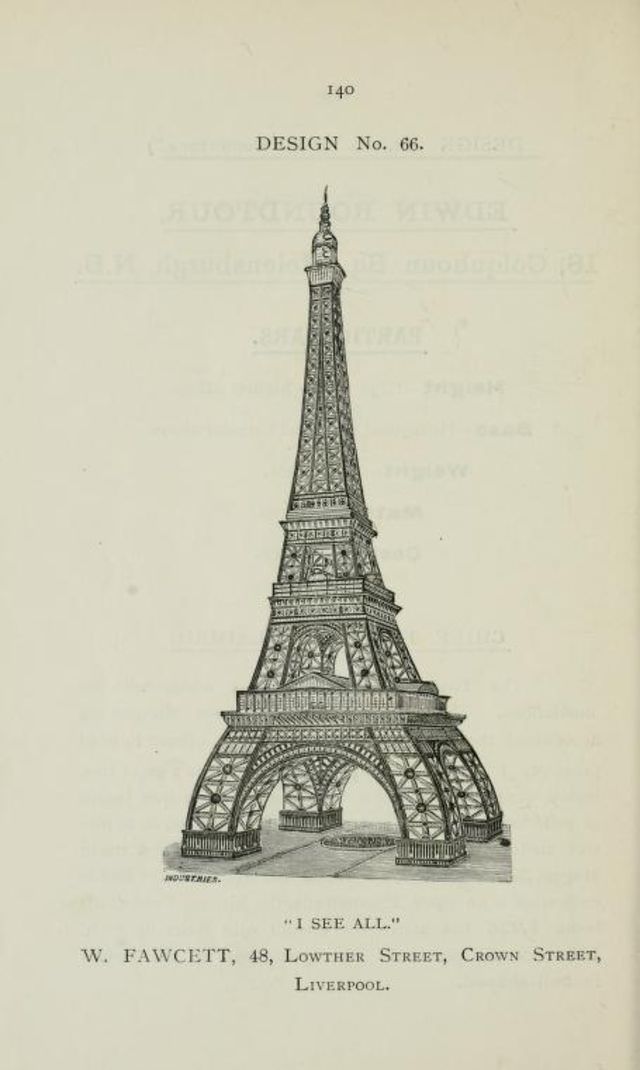
Numbered like an entry in a competition catalogue, “DESIGN No. 66” rises from the page as a bold proposal for a “Great Tower for London,” reflecting the late‑Victorian hunger for engineering spectacle. The draughtsman renders an open-lattice monument with an immense arched base and stacked platforms, a silhouette that nods to the era’s fascination with iron construction and panoramic viewing. Even the caption “I SEE ALL” reads like marketing copy for a new kind of urban attraction—part landmark, part machine for seeing the city.
Closer inspection reveals how carefully the concept is sold through detail: repeating truss patterns, decorative bands, and a crown-like top that suggests both stability and grandeur. The base is treated almost like a gateway, broad enough to swallow the street, with a central passage and smaller structural bays that imply circulation, ticketing, or service spaces. On the printed page, the fine linework and measured symmetry evoke the world of exhibitions, patents, and illustrated “inventions” that promised modernity in steel.
Beneath the drawing, a credit line points to W. Fawcett of Liverpool, hinting at the wide geographic reach of the competition and the sheer volume of ambitious submissions. With over 50 competitive designs said to have been entered, this image stands as a vivid reminder that London’s skyline could have taken many different forms in 1890, shaped by rival visions of height, novelty, and public entertainment. For anyone researching Victorian architecture, proposed towers, or the history of London landmarks that never were, this design is a striking piece of the story.