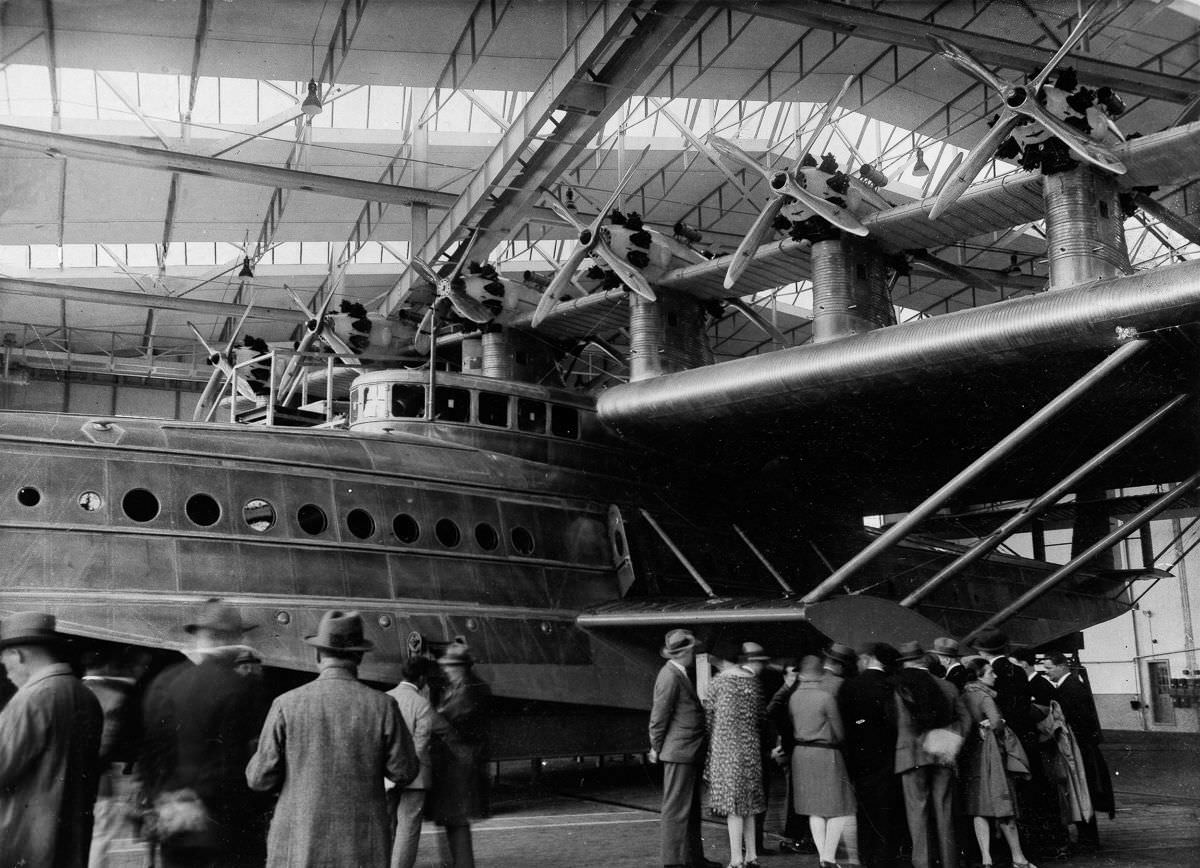
Inside the vast assembly hangar at Altenrhein, Switzerland, a completed Dornier Do X dominates the frame on July 9, 1929, its boat-like hull stretching across the floor like a steel ship that learned to fly. Overhead, the hangar’s trusses and skylights create a lattice of light and shadow, emphasizing the sheer scale of the aircraft. Along the fuselage, neat rows of round porthole windows hint at ambitions beyond test flights—this was an era when air travel was being sold as modern, comfortable, and almost nautical in its promise.
Crowds gather at the bottom edge of the scene, their hats and long coats underscoring how enormous the flying boat appears when measured against everyday people. The Do X’s wing bristles with multiple engine nacelles and propellers, a mechanical chorus lined up in pairs that suggests the engineering challenge of lifting such mass from water into air. Struts and supports angle forward like the rigging of a vessel, reinforcing the hybrid identity that made flying boats such a compelling solution for long-distance routes before widespread runway infrastructure.
Viewed today, this historical photo reads like a portrait of interwar optimism, when invention and spectacle often went hand in hand. The Dornier Do X stands not just as an aircraft, but as a statement piece—industrial craftsmanship staged in a cathedral-like workspace for visitors to admire. For anyone searching the history of aviation in Switzerland or the story of early giant seaplanes, this moment in Altenrhein captures the meeting point of factory precision, public curiosity, and the dream of conquering distance by air.