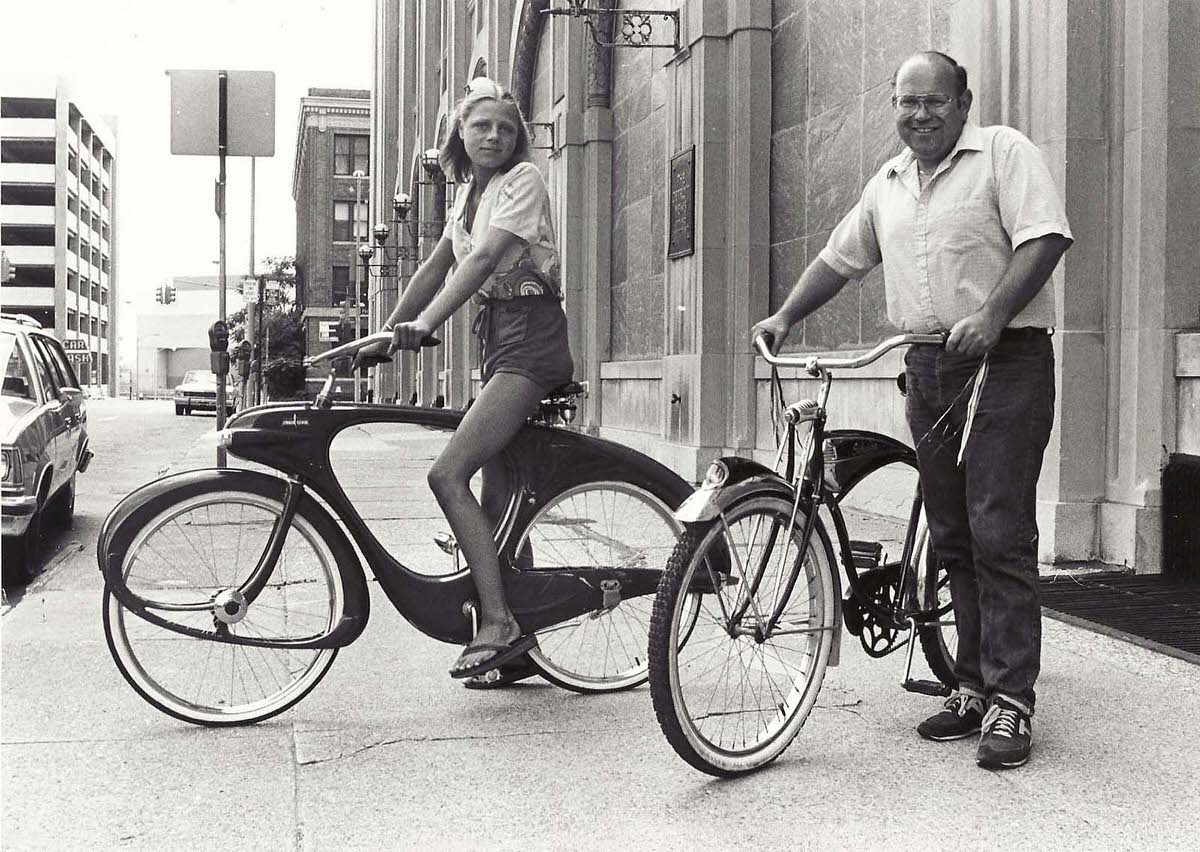
Outside a stone-fronted downtown building, two riders pose with machines that look more like concept cars than ordinary bicycles. The design’s sweeping, enclosed frame dominates the sidewalk scene, turning a simple street moment—parked cars, tall façades, and a distant intersection—into a small exhibition of industrial imagination. One bicycle sits low and sculptural, its continuous bodywork hugging the wheels and inviting the eye to trace the curve from head tube to rear fender.
That distinctive silhouette points straight to the Spacelander, a rare classic bicycle whose futuristic styling set it apart from the chrome-and-tube norm. In the photo, the contrast is striking: the streamlined “space-age” bike beside a more conventional bicycle, both held proudly as if to underline what made the experiment so bold. Details like the broad frame fairing, integrated fenders, and smooth lines signal a period when consumer design was willing to take big aesthetic swings.
Only 522 Spacelander bicycles were shipped before production was halted, and that scarcity has helped transform surviving examples into coveted artifacts of mid-century innovation. Images like this one do more than document a product—they capture the optimism that everyday transportation could be redesigned with the language of rockets, jets, and tomorrow. For collectors, cycling historians, and anyone drawn to retro-futurism, the Spacelander remains a reminder that even a bicycle can become a symbol of an era’s dreams.