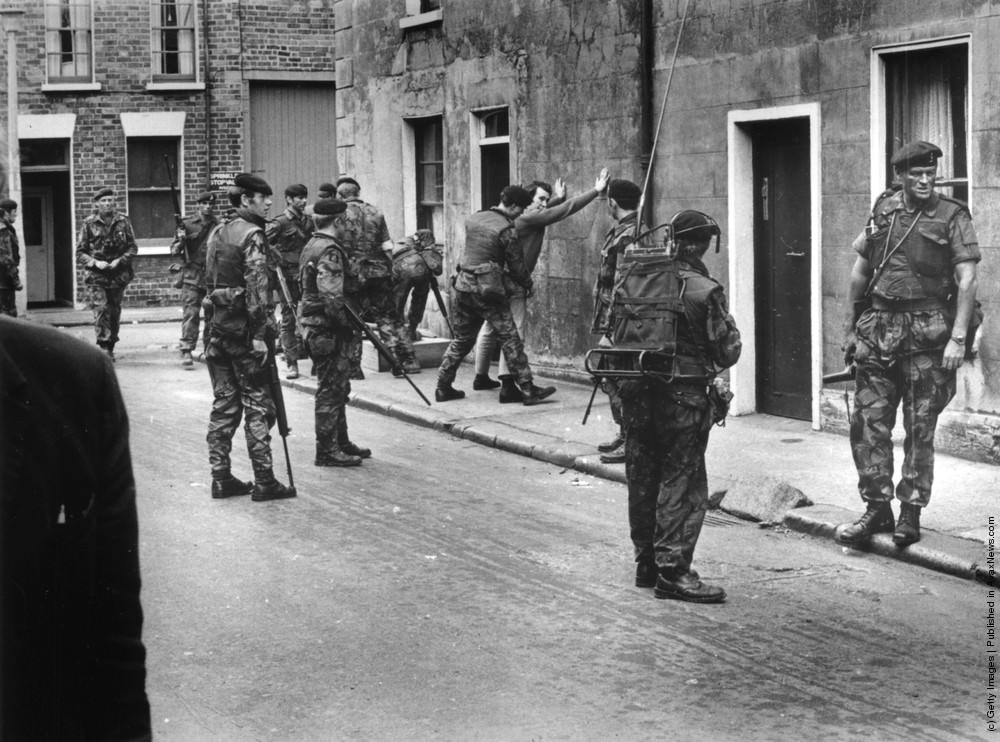
Along a narrow Belfast street, British soldiers in combat gear form a loose cordon while a civilian is pressed to a wall, arms raised, as a search is carried out. Rifles hang at the ready, backpacks and radios ride high on tired shoulders, and a lone figure watches from the edge of the frame, half-cut off like an interrupted thought. The surrounding brick façades and worn doorways turn everyday housing into a temporary checkpoint.
Dated 12th August 1971, the moment speaks to the tense routines of security operations during the Troubles, when suspicion and control could settle over ordinary neighbourhoods. The body language does much of the talking: the searched man held still, the searcher leaning in, others scanning the street for movement beyond the camera’s view. Even without audible noise, the photo suggests the clipped commands and uneasy silence that accompanied street searches and house-by-house scrutiny.
For readers exploring civil conflict history, Belfast history, or British Army operations in Northern Ireland, this image offers a stark, grounded view of how political crisis reshaped daily life. It is not a battlefield scene but a portrait of authority exercised at close range, where the distance between soldier and civilian collapses to a few inches of pavement and plaster. Such photographs endure because they preserve the texture of a city under strain—mud on boots, chipped masonry, and the weight of a single encounter frozen in time.