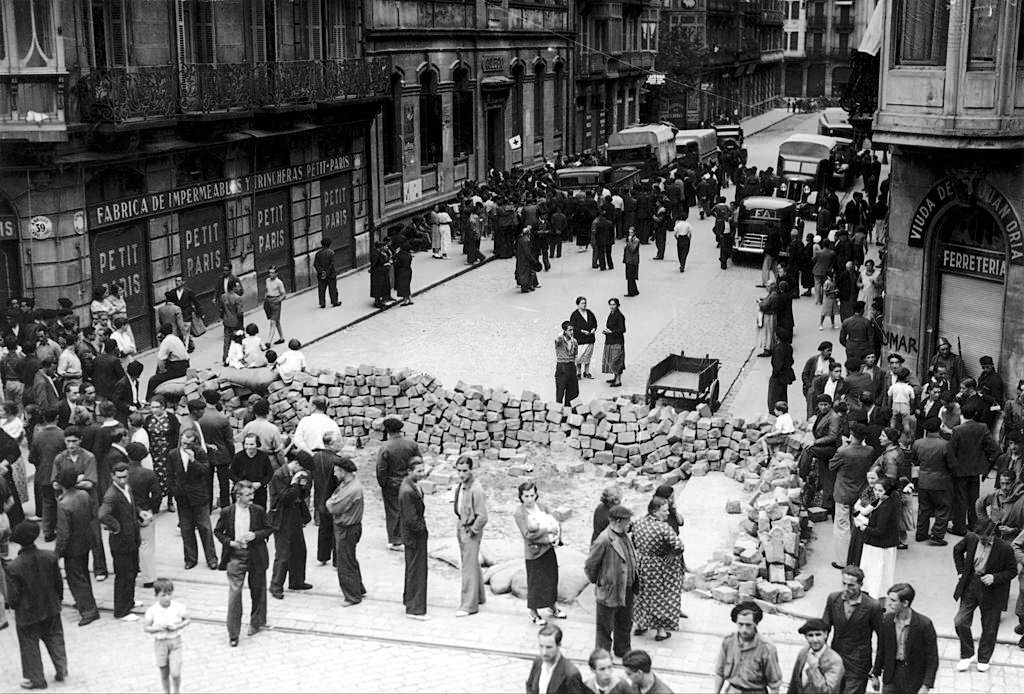
Stones pulled from the street have been stacked into a low, jagged barricade that cuts across a broad avenue in San Sebastián, turning an everyday commercial block into a defensive line. Shopfronts with painted signage and shuttered windows frame the scene, while the masonry heap sits like an improvised fortification against the smooth roadway. The title places this moment in 1936, at the outset of Spain’s Civil War, when control of public space could change hands in hours.
Crowds gather on both sides—men in work clothes and jackets, women in dresses, children lingering at the edge—creating a tense mix of curiosity, urgency, and watchful restraint. A few carts and early motor vehicles wait farther up the street, suggesting movement slowed to a crawl by the obstacle and the uncertainty around it. In the absence of uniformed authority, the street itself becomes the stage where civilians negotiate danger, rumor, and survival.
Barricades like this were more than piles of stone; they were statements of power, solidarity, and fear, erected quickly from whatever the city could provide. For readers searching the Spanish Civil War in San Sebastián, anarchist street tactics, or urban life under revolutionary pressure, the photograph offers grounded detail: architecture, crowd behavior, and the practical mechanics of turning a neighborhood into a front line. It’s a reminder that civil wars are fought not only in distant battlefields, but in familiar streets where ordinary routines are abruptly interrupted.