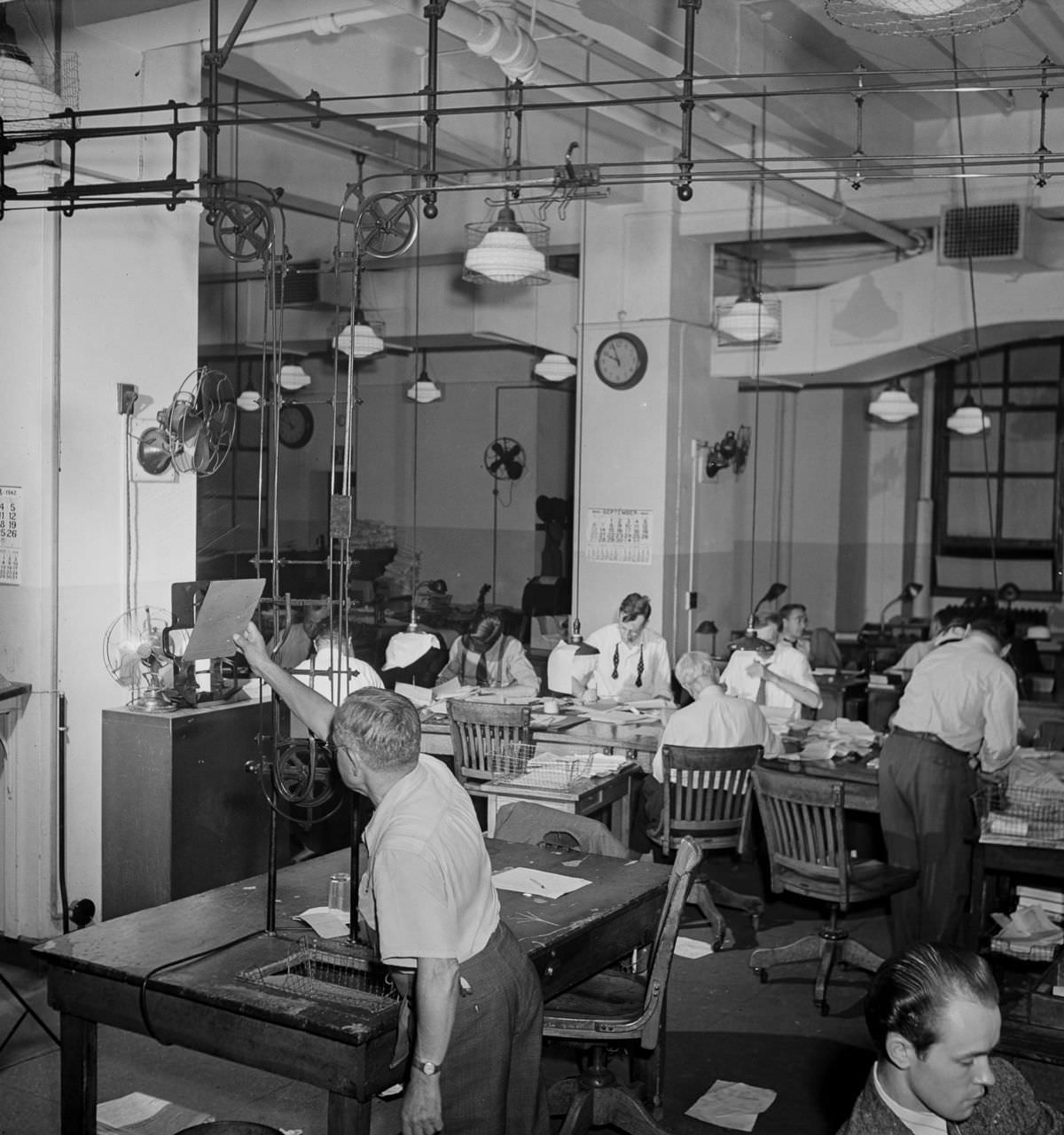
Overhead, a web of rails, pulleys, and belts turns the newsroom ceiling into a working highway, built to keep words moving as fast as the news itself. Beneath the hanging lights and wall clocks, editors and copyreaders bend over crowded desks, their paper stacks, wastebaskets, and wire trays forming a landscape of constant revision. The title points your eye to the real protagonist: a conveyor system that carries finished copy up to the composing room, shaving minutes from the journey between writing and print.
At the left edge, a worker reaches up with a sheet in hand, feeding the mechanism that will whisk it away, while the rest of the room stays absorbed in marking, sorting, and preparing the next pieces. Fans, exposed beams, and industrial fixtures hint at the heat and noise such spaces could generate, even if the photograph itself is silent. It’s a reminder that the “newsroom” was not only a place of ideas and deadlines, but also a carefully engineered workflow where mechanical invention supported editorial labor.
Seen today, this scene reads like a missing chapter in the history of publishing technology: an analog information pipeline designed for speed, accuracy, and volume. Long before email, shared drives, and content management systems, newspapers relied on physical logistics to connect reporters, editors, and typesetters across floors. For anyone exploring inventions in journalism, printing history, or the evolution of newsroom process, the conveyor belt above these desks captures how innovation quietly shaped what readers held in their hands each day.