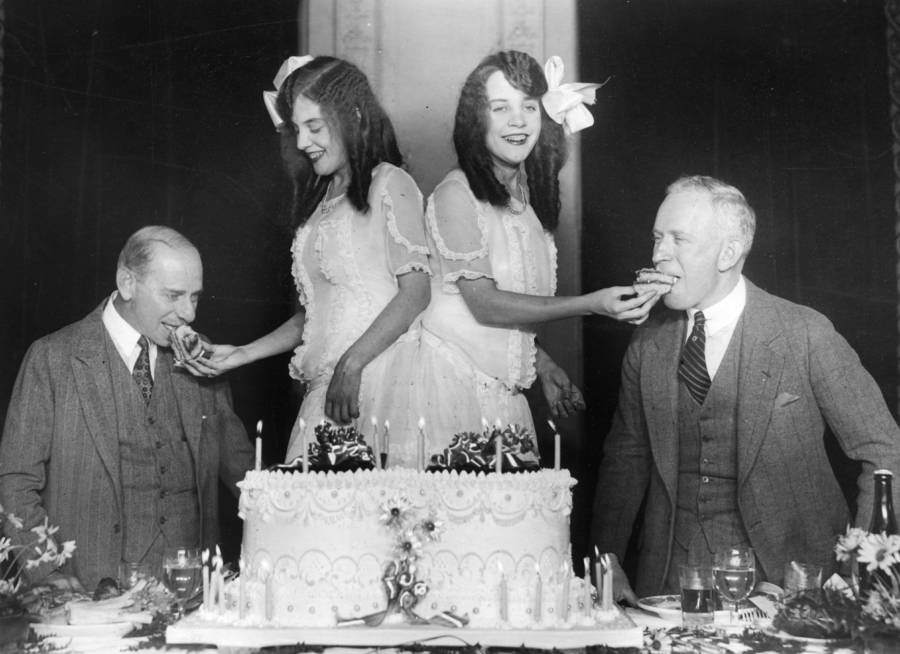
Daisy and Violet Hilton stand at the center of a birthday table, dressed in light-colored party gowns with matching hair bows, their expressions caught between poise and playful delight. A large frosted cake dominates the foreground, candles lit and clustered like a small skyline, while place settings and glassware hint at a formal celebration staged for company. On either side, two well-dressed men lean in, smiling as the sisters offer bites of cake, turning a posed moment into something that feels briefly intimate.
The title places this scene in the Hilton sisters’ American touring years, when British conjoined twins were marketed as headline attractions in the 1930s sideshow circuit. Photos like this worked as publicity as much as remembrance—proof of youth, glamour, and “normal” milestones presented to the public, even as the realities of exhibition life remained largely off-camera. The contrast is striking: a sweet 17th birthday ritual framed by the machinery of entertainment, with the twins’ charm made to carry the story.
For readers searching the history of Daisy and Violet Hilton, this image offers a doorway into wider questions about disability, spectacle, and agency in early 20th-century popular culture. The careful styling, the celebratory cake, and the cooperative smiles suggest how promoters and press preferred to package their lives—romantic, palatable, and easy to consume. Yet the sisters’ direct presence in the frame resists simplification, inviting us to look longer and consider the people behind the poster-ready moment.