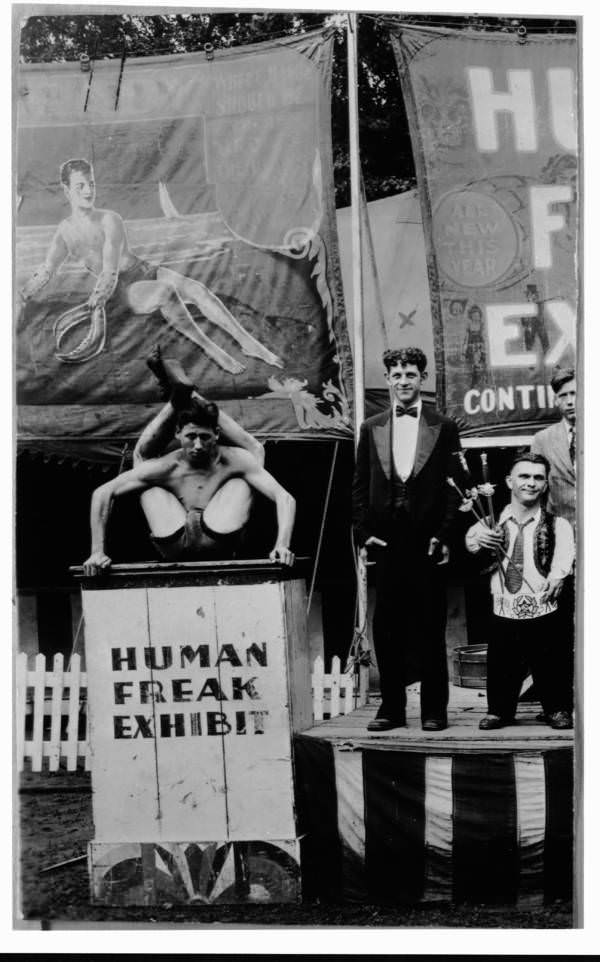
Under the canvas of a traveling midway, a contortionist folds his body into an almost impossible knot atop a small platform, framed by painted banners and bold lettering meant to stop passersby in their tracks. The staging is loud and deliberate: a picket fence, striped skirting, and showman-style signage that turns human anatomy into an attraction. Even without movement, the pose conveys the physical discipline behind the act—strength, flexibility, and endurance compressed into a single, unsettling moment.
On the front of the stand, the words “HUMAN FREAK EXHIBIT” announce the era’s blunt marketing language, a reminder of how sideshows sold “difference” as spectacle in the 1920s. Nearby figures in formalwear and performance costume hold their positions like a cast at curtain call, suggesting the blend of carnival business and theatrical presentation that kept these exhibits profitable. The contrast between the performer’s vulnerability and the surrounding confidence of the show’s operators is hard to miss.
Seen today, a photo like this invites more than morbid curiosity—it opens a conversation about labor, entertainment, disability history, and the ethics of public display. The title’s quoted word “freak” signals the term’s loaded past, and the image makes clear how openly it was used to draw crowds. For readers exploring circus history, sideshow culture, or early twentieth-century popular entertainment, this 1925 snapshot is a stark artifact of both showmanship and social attitudes.