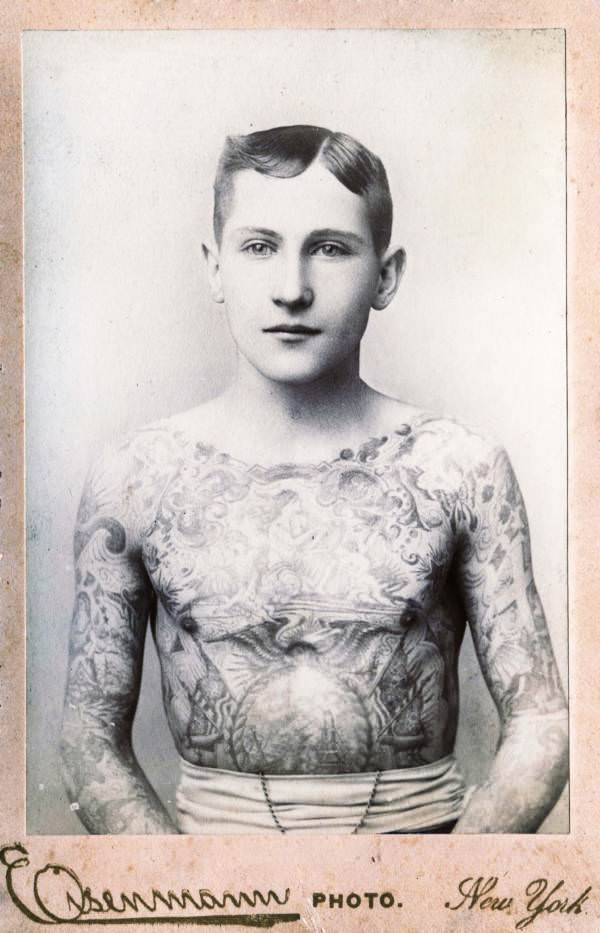
Against a plain studio backdrop, a young man faces the camera with a steady, almost formal calm—yet his bare torso tells the real story. The cabinet photograph, identified in the title as New York, New York, 1890, records a body covered from chest to wrists in dense tattoo work, arranged like an intricate garment. Even in soft, aged tones, the contrast between his neat hairstyle and the profusion of ink makes the portrait impossible to dismiss.
Look closer and the tattoos resolve into layered motifs: curling shapes, shaded panels, and bold outlines that flow across both arms and over the chest, with a large central design anchoring the abdomen. The overall effect is symmetrical without being rigid, suggesting careful planning and many hours under the needle. In an era when most portraits emphasized clothing, occupation, and respectability, he presents his skin as his statement, turning the studio into a stage for self-invention.
Cabinet cards were meant to be handled, collected, and shared, and this one offers a rare window into late-19th-century tattoo culture in New York City. It hints at the worlds where extensive tattoos were seen—sailors, performers, and other urban subcultures—while also showing how photography could legitimize what society often labeled “strange.” For readers interested in tattoo history, Victorian body art, and American portrait photography, this image preserves a striking moment when personal identity was literally written on the body.