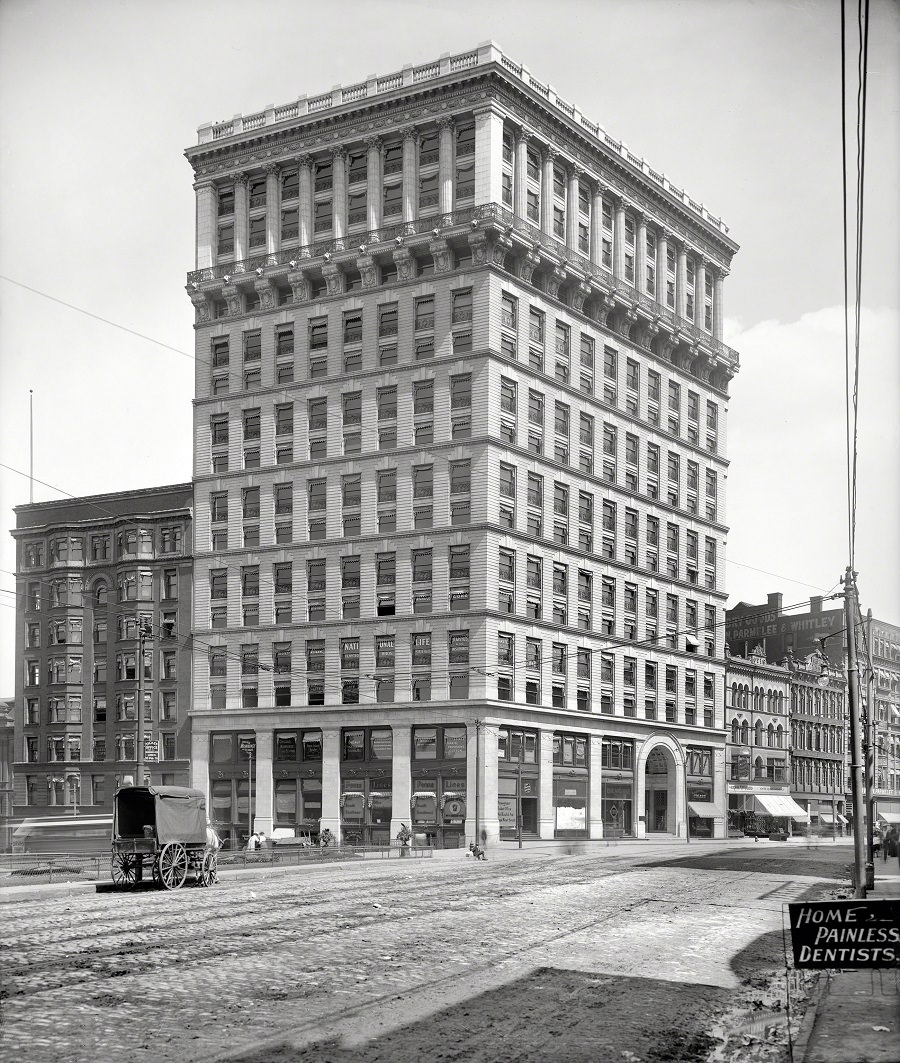
Rising above Euclid Avenue, the Williamson Building commands the block with a stacked rhythm of windows, pilasters and an emphatic cornice that announce its early commercial-classical design. The ground floor shows large storefront openings and a prominent arched entrance that would have welcomed businesses and clients around circa 1900. Fine stonework and the upper colonnaded loggia create a clear hierarchy between retail base, repetitive office floors, and an ornamented top—typical of prosperous downtown Cleveland architecture at the turn of the century. On the street below, a cobblestone roadway, a horse-drawn carriage and a smattering of pedestrians convey everyday life around the building, while a web of overhead wires hints at the era's evolving urban transit. Window signs and small shopfronts line the base; a visible sign reading "Home Painless Dentists" offers a human detail that anchors the scene to commercial services common on Euclid Avenue. The juxtaposition of monumental office facades and street-level commerce illustrates how business, transport and daily routines intersected in early 20th-century city centers. Viewed today as both an architectural specimen and a photograph of urban life, the scene provides historians and enthusiasts a vivid snapshot of Cleveland's downtown development along Euclid Avenue circa 1900. Researchers of historic architecture will notice the building's classical proportions and ornamentation, while social historians can read the photograph for clues about mobility, retail, and professional services in the period. For anyone tracing the evolution of downtown Cleveland, the Williamson Building image remains a compelling starting point for exploring the city's commercial growth and streetscape transformation.