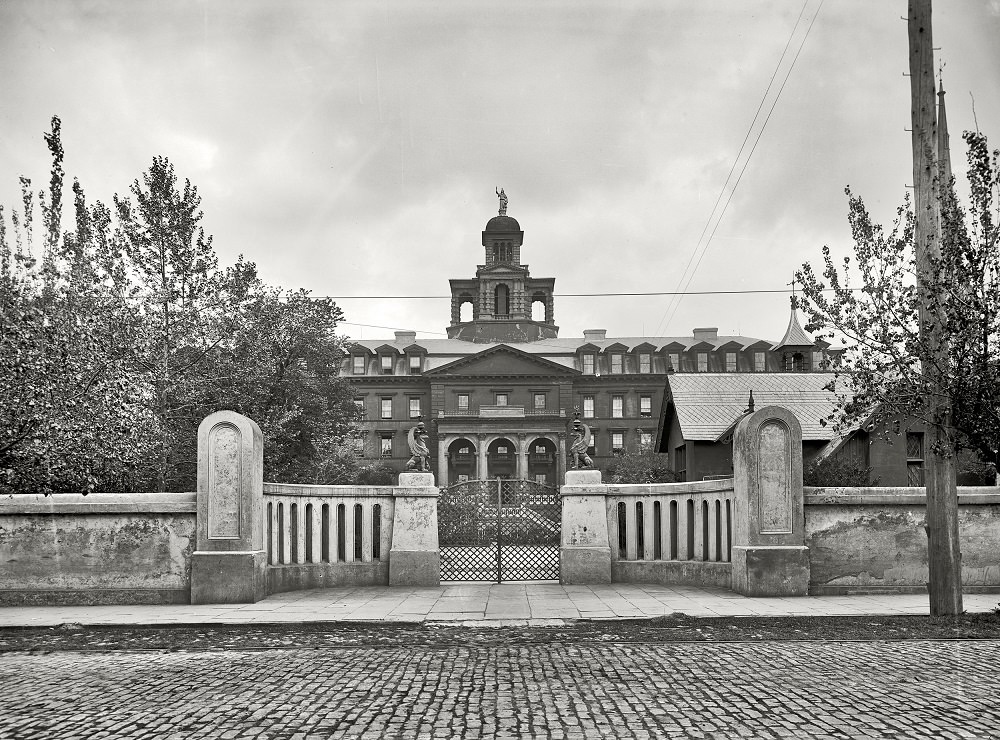
Behind a low wall and iron gate, the Charleston Orphan House rises with a formal, almost civic grandeur that signals how seriously the city took the work of institutional care around 1900. The broad, symmetrical façade, punctuated by dormer windows and a central entrance, reads like a public monument as much as a residence. Even the cobblestoned street in the foreground adds texture to the scene, placing the building within the everyday rhythms of Charleston life.
Architectural details draw the eye upward from the fenced approach to the upper stories and the prominent cupola above the roofline. Trees soften the edges of the property, while a smaller outbuilding at the side hints at the practical routines required to keep such a place running—food, laundry, maintenance, and the countless tasks that filled each day. Overhead lines and a tall utility pole quietly mark a city in transition, where older streetscapes met the technologies of a new century.
For readers interested in Charleston history, social welfare, and the built environment of the American South, this photograph offers more than a simple view of a landmark. It suggests the tension between shelter and separation: a welcoming entrance framed by barriers, an orderly campus set slightly apart from the street. As a piece of Places & People, the image invites questions about the children who passed through those gates and the community systems—charitable, religious, and civic—that shaped their lives.