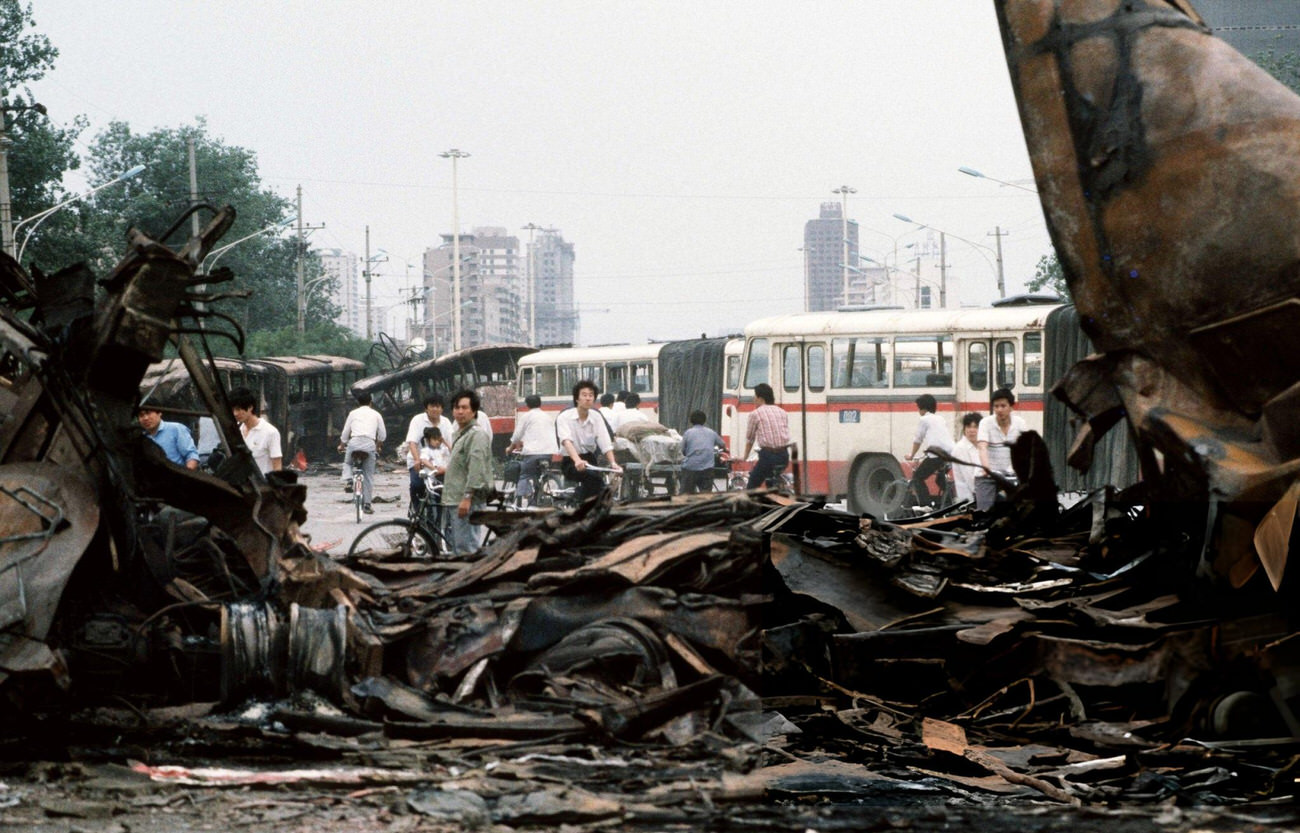
Shredded metal fills the foreground like a collapsed roof, its twisted sheets and blackened beams forming a jagged frame around a city street. Beyond the wreckage, onlookers in everyday clothes move carefully through the scene—some on bicycles—pausing to stare at what remains of buses that had been turned into barricades. Intact vehicles sit farther back, their pale sides and red stripe contrasting with the burnt hulks and scattered debris.
The title points to 1989, a year when public space became a battleground of will and symbolism, and ordinary infrastructure was repurposed into makeshift defenses. Here, the buses that once carried commuters now read as blunt instruments of resistance and, afterward, as evidence of overwhelming force—run over by Chinese Army tanks and left mangled in place. Streetlights, trees, and distant high-rises stand as quiet witnesses, emphasizing how quickly a familiar urban landscape can be transformed by civil unrest.
What lingers most is the human scale: people close enough to inspect the damage, yet separated from it by caution, curiosity, and shock. The photograph preserves a moment after the roar has passed, when communities begin the difficult work of understanding what happened and what it means. For readers searching for historical photos of the 1989 crackdown, Tiananmen-era aftermath, or images of destroyed buses used as barricades, this scene offers a stark, unembellished record of conflict’s imprint on the everyday city.