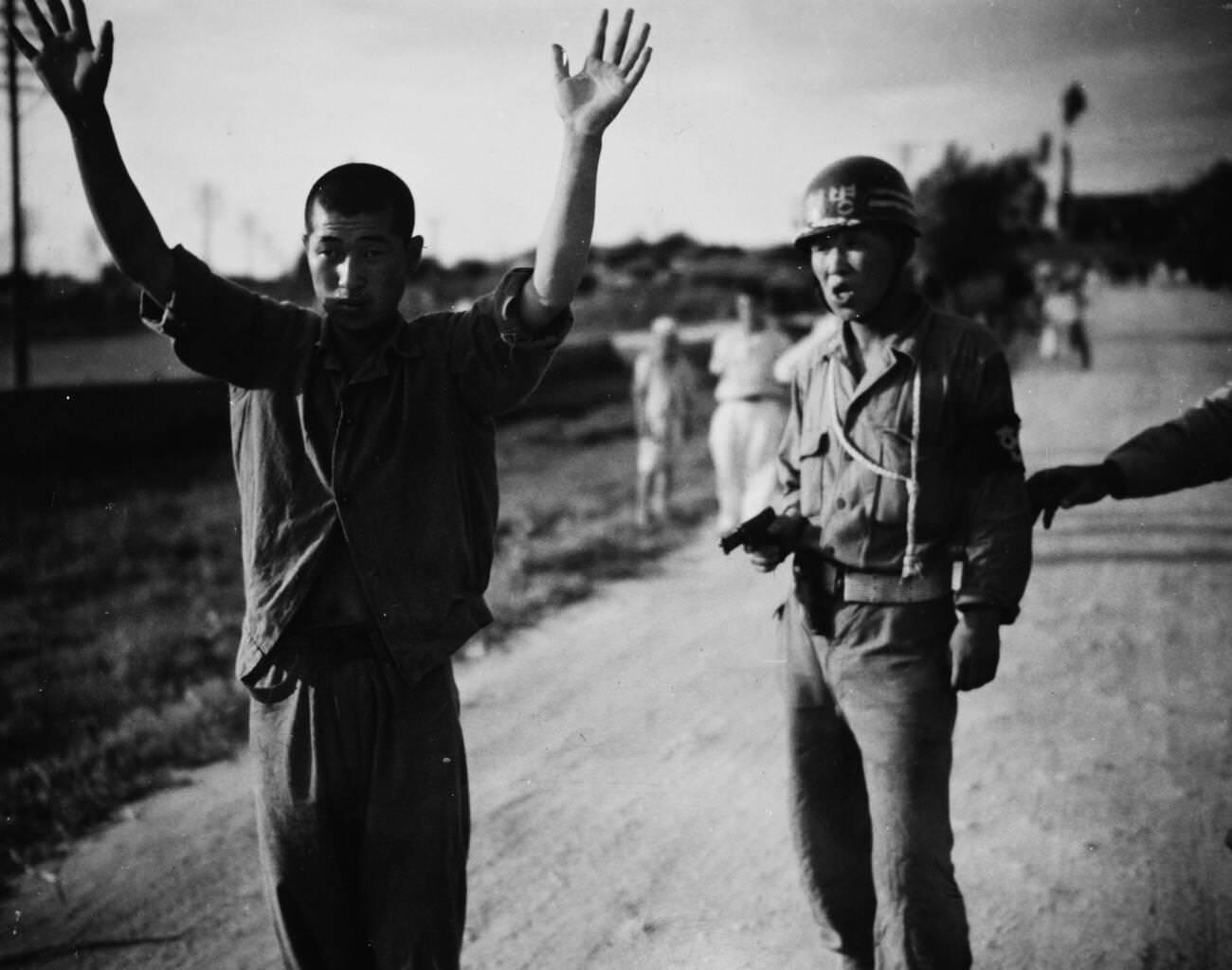
Arms raised high, a young North Korean prisoner of war walks along a dusty road while a South Korean military policeman keeps close watch at his side. The contrast is immediate: the prisoner’s open hands and tense posture against the policeman’s helmeted presence, uniform, and sidearm. In the distance, blurred figures and a wide, open landscape hint at a larger movement of troops and captives beyond the frame.
Details in the scene speak to the routines of wartime control and surrender during the Korean War in 1950. The military policeman’s stance suggests authority and urgency, while the prisoner’s raised arms signal compliance and vulnerability—an instant of human drama reduced to simple gestures. Even without a visible battlefield, the photograph conveys how conflict extends onto ordinary roads and into the lives of individuals swept up by shifting front lines.
For readers exploring Korean War history, prisoner-of-war experiences, and military policing in early Cold War Asia, the image offers a stark, grounded reference point. It captures the uneasy space between combat and captivity, where a single escort and a single captive represent vast armies and political stakes. The photograph’s power lies in its ambiguity: no speeches, no maps—only a march, a watchful guard, and the silence of a road leading forward.