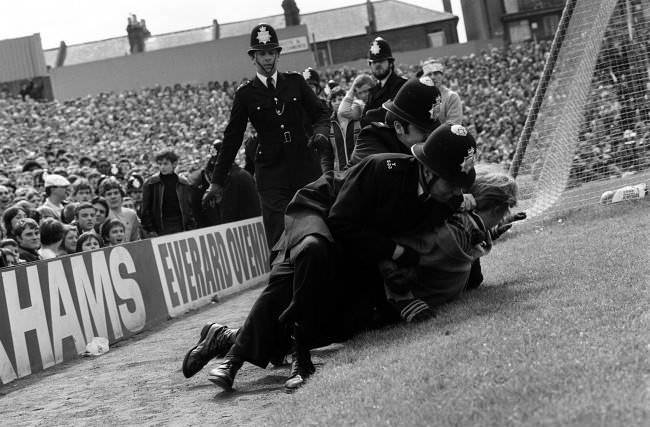
Chaos breaks through the touchline as uniformed police pile in to restrain a spectator on the turf, right beside the pitch-side advertising boards and the edge of the goal net. The officers’ helmets and heavy coats contrast sharply with the vulnerable sprawl of bodies on the grass, while one constable stands alert behind them, watching the wider crowd. In the background, a tightly packed sea of faces fills the terraces, capturing the pressure-cooker atmosphere that could surround major sports fixtures in the 1980s.
Along the barrier, bold sponsor lettering and discarded cups underline how close supporters were to the action in many older stadium layouts, with only a low partition separating thousands from the field of play. The scene hints at a sudden pitch incursion or flashpoint—an instant when the game becomes secondary to crowd control and safety. That uneasy closeness between players, officials, and spectators is part of what makes this kind of sports history photo so compelling for collectors and researchers alike.
Moments like this sit at the intersection of football culture, policing, and public order, illustrating why debates around stadium security and fan behaviour intensified during the late twentieth century. For anyone searching for an authentic 1980s sports crowd image, this photograph offers gripping detail: the crush of the stands, the immediacy of the sideline, and the swift, physical response on the ground. It’s a stark reminder that the story of sport isn’t only written in goals and trophies, but also in the tensions that played out just feet from the pitch.