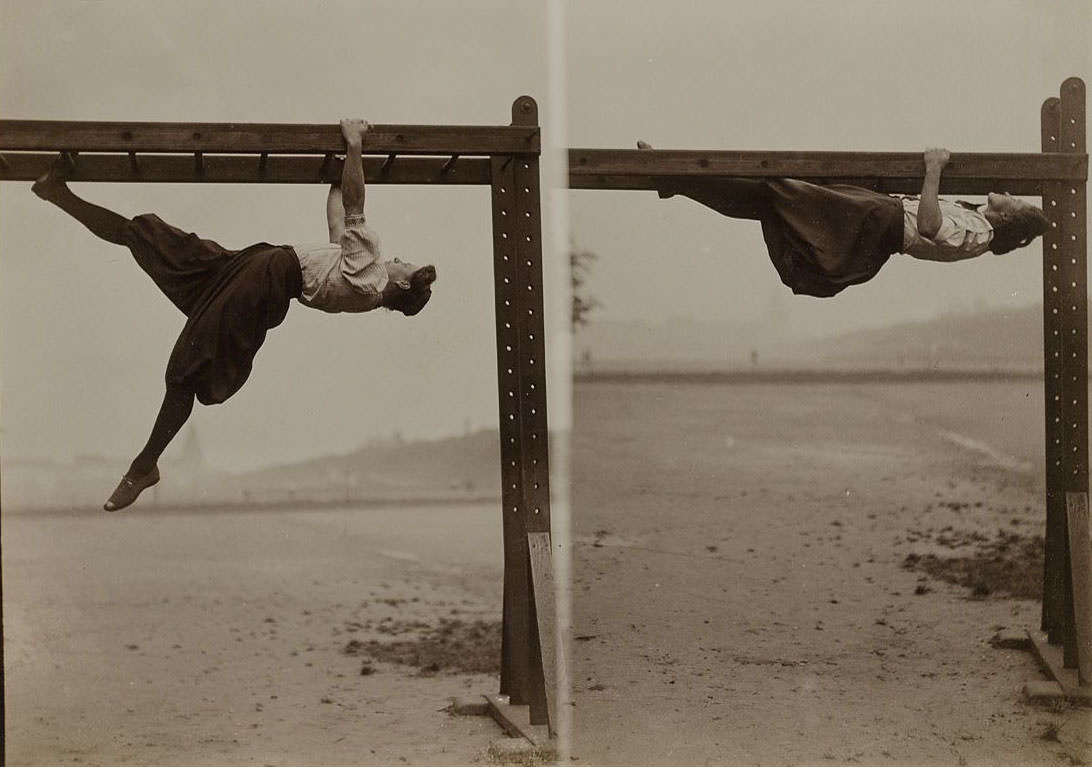
Balanced on sturdy horizontal bars, two German women hold themselves aloft in striking poses that blend strength with control, a hallmark of Swedish gymnastics. Their long skirts and fitted blouses remind us how early-1900s sports culture often adapted athletic movement to contemporary dress, making the discipline look both formal and daring. The open, sandy ground and spare background keep attention on the bodies in motion and the simple training apparatus.
Swedish gymnastics, with its emphasis on posture, measured exercises, and disciplined physical education, spread widely across Europe and found a place in German training traditions. In Heinrich, Germany, this kind of practice suggests organized instruction—likely part of a club, school program, or community physical culture movement—where women were increasingly encouraged to pursue fitness and coordinated exercise. The photo’s symmetry and timing capture a moment of athletic confidence, not merely recreation.
Sports history often turns on small details, and here the grip on the bar, the angle of the torso, and the pointed feet speak to practiced technique rather than improvisation. For readers interested in women’s athletics, physical education, and European gymnastics in the 1900s, this image offers a vivid glimpse into how training looked outside modern gymnasiums. It’s an evocative record of early twentieth-century sport in Germany, where discipline, health, and display met on a simple set of bars.