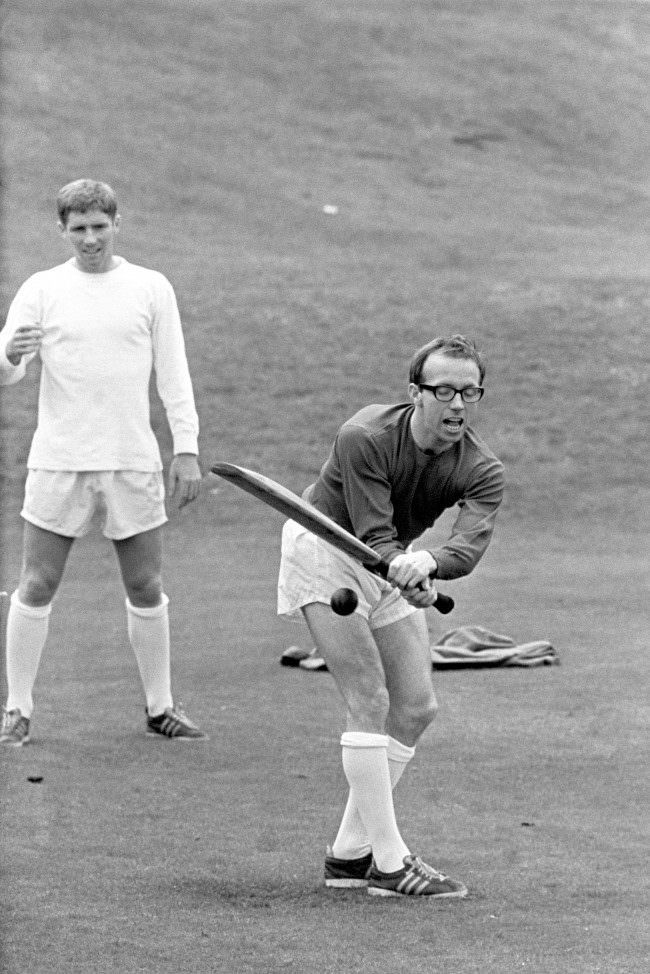
On a quiet training ground in Roehampton, London, the England squad’s pre-match routine takes an unexpectedly playful turn as Nobby Stiles swaps football boots for a cricket bat. He’s caught mid-swing in long-sleeved kit, glasses on, eyes fixed on the ball as it skims up from the turf—an instant of concentration that still feels lively decades later. Behind him, Alan Ball stands ready in the field, relaxed but alert, underscoring how even downtime carried an edge of preparation.
Moments like this reveal the texture of the 1966 World Cup camp beyond the stadium lights: teammates passing time, loosening muscles, and sharpening reflexes in any game they could improvise. The choice of cricket is telling—hand-eye coordination, quick reactions, and competitive banter translate neatly into football training, especially with Wembley looming. The open grass and minimal equipment keep the focus on movement and camaraderie, the sort of simple practice that builds a unit as much as it entertains.
For fans searching for 1966 England World Cup history, Nobby Stiles and Alan Ball appear here in a candid, human scene that contrasts with the high-stakes narrative of the semi-final against Portugal at Wembley Stadium. It’s a reminder that legendary campaigns are made not only in matches and tactics, but also in small rituals that settle nerves and keep spirits light. The photograph captures preparation as lived experience—work disguised as play, with two iconic figures at its centre.