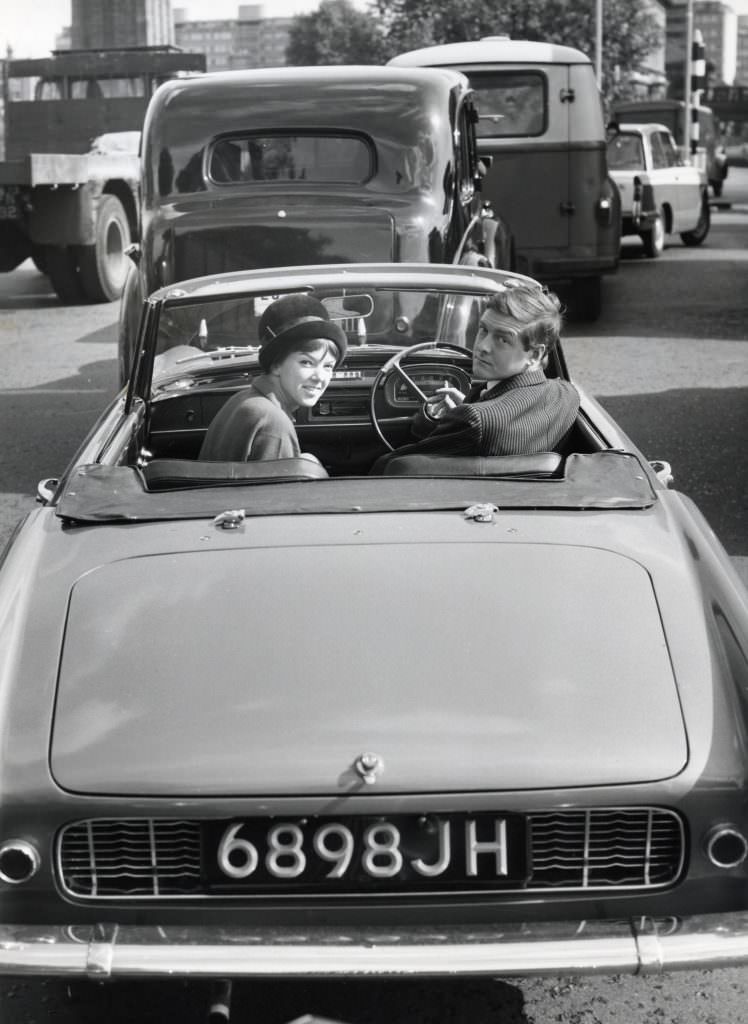
From the back seat of a small open-top car, Mary Quant and her husband, Alexander Plunkett Greene, glance over their shoulders toward the camera, turning an everyday moment in traffic into a neatly staged slice of 1965. Quant’s compact hat and bright, knowing smile contrast with the more reserved look of her partner at the wheel, while the low windscreen and tidy dashboard frame them like a scene from a swinging-era film still. The crisp black-and-white finish sharpens details—chrome trim, rounded bodywork, and the bold registration plate—making the vehicle as much a character as its passengers.
Behind them, larger cars and vans crowd the road, hinting at the bustle of a modernising Britain where postwar streets were filling fast. The composition plays with scale and status: the couple’s sleek convertible sits in the foreground while utilitarian vehicles loom ahead, a visual shorthand for the decade’s mix of aspiration and practicality. With no dramatic backdrop required, the surrounding traffic supplies context—urban movement, daily rhythm, and the sense of a city always in motion.
Linked to the legend of King’s Road, the mini-skirt, and the wider cultural shake-up of the 1960s, Quant appears here not as a distant icon but as a working creative caught mid-journey. The photo’s casual glamour speaks to why she became synonymous with youth-driven UK fashion: approachable, modern, and slightly mischievous, yet unmistakably confident. For readers searching vintage fashion history, Mary Quant 1965, or the origins of British style revolution, this image offers an intimate portal into the period’s attitude—forward-looking, street-level, and alive with possibility.