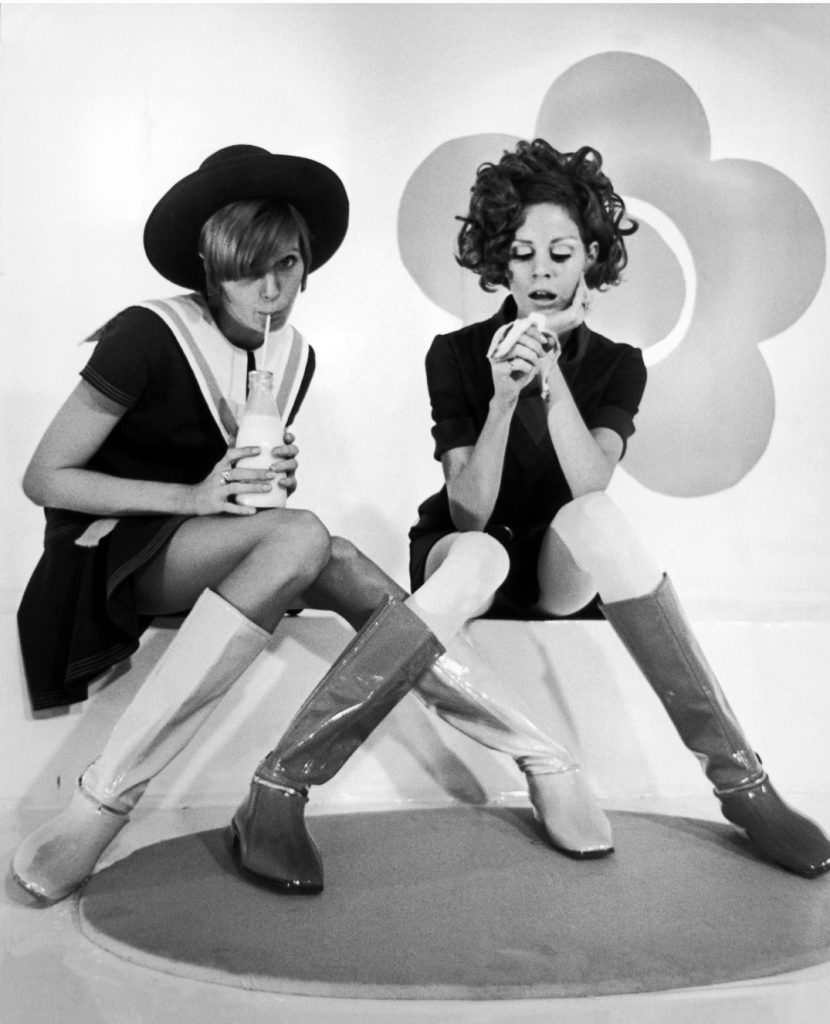
Murph and Jackie Bowyer lounge with the easy irreverence of mid‑1960s youth culture, presenting Mary Quant styles at the Carlton Hotel on August 15, 1967. One model sips from a bottle through a straw beneath a wide-brim hat, while the other studies something in her hands, their poses relaxed rather than prim. The playful informality feels deliberate, as if the catwalk has been replaced by a scene from everyday life—exactly the kind of attitude that helped make Quant’s look feel modern.
Bold, graphic fashion details do much of the storytelling: short hemlines, clean lines, and a strong contrast of dark fabric against crisp white accents. Knee-high, high-shine boots dominate the foreground, a signature accessory of the era that reads instantly as Swinging Sixties. Behind them, a large flower-like motif on the backdrop echoes pop-art simplicity, turning the hotel setting into a stage set for London-influenced mod style.
More than a record of a fashion presentation, the photograph functions as a snapshot of cultural change, when clothes signaled freedom, movement, and a rejection of stiff formality. Quant’s designs—associated with King’s Road energy and the mini-skirt’s rise—appear here as part of a broader shift toward youthful, accessible style. For anyone searching the history of 1960s fashion, Mary Quant, mod boots, and the mini-skirt moment, this image distills the era’s mix of chic design and cheeky confidence.