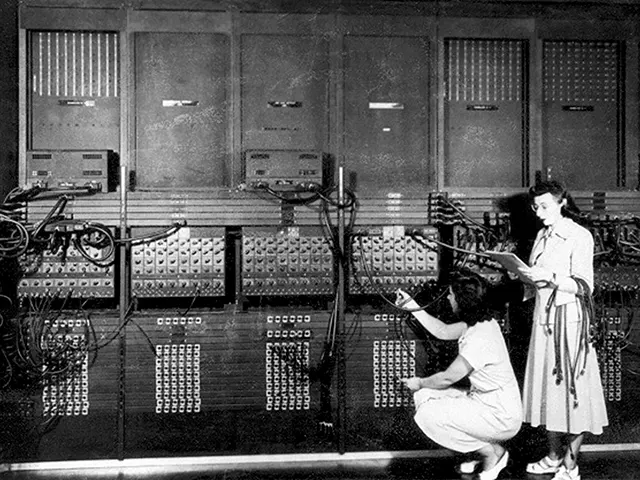
Banks of panels, cables, and dials stretch across the frame like an industrial wall, emphasizing the sheer physical scale of early computing. In the foreground, Marlyn Wescoff stands with papers in hand while Ruth Lichterman works closer to the machine, their attention fixed on the maze of plugboards and switches that governed ENIAC’s behavior. The scene is quiet but charged with purpose: programming here was a hands-on craft, performed with tools, notes, and careful coordination rather than a keyboard.
Reprogramming ENIAC in 1946 meant translating mathematical intent into a precise configuration of connections, settings, and sequences—an intricate choreography across a room-sized computer. The photo highlights the reality behind a term we now use casually: “software” had not yet taken the form of stored code, so changing a calculation could require rerouting cables and resetting hardware modules. Details like the dense arrays of sockets and the sprawling wiring underline how experimental, manual, and exacting this work could be.
Seen today, the image offers a vivid window into the origins of computer programming and the often-overlooked labor that made early electronic computation practical. It pairs the iconic architecture of ENIAC with the human expertise needed to operate it, reminding readers that innovation was not only built in metal and circuitry but also in planning, verification, and problem-solving. For anyone exploring the history of inventions, women in computing, or the story of ENIAC, this photograph serves as a compelling starting point.