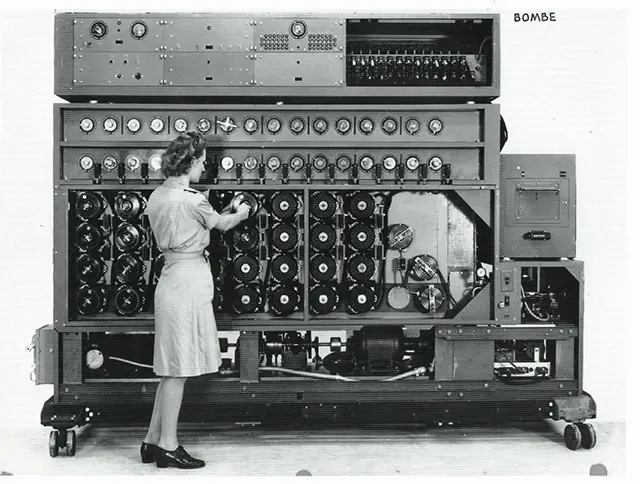
Rows of circular dials and stacked rotors dominate the frame as a woman stands at the center of an imposing Bombe computing device, hands raised in mid-adjustment. The machine’s open panels expose a dense interior of wiring, switches, and repeating mechanisms, turning the work of calculation into something tactile and mechanical. Even without a close-up of her expression, her poised stance suggests practiced attention—an operator reading the instrument panel the way a musician reads a score.
The word “BOMBE” printed at the top reinforces what the hardware already implies: this is an early era of codebreaking technology, when problem‑solving relied on electromechanical ingenuity rather than screens and software. Details like the extensive gauge array, the uniform rhythm of components, and the industrial base on wheels evoke a workspace where machines were maintained, tuned, and monitored continuously. It’s a reminder that the history of computing is also the history of skilled labor—careful setup, routine checks, and quick decisions made in front of loud, complex equipment.
For readers interested in inventions and the roots of modern computing, this historical photo highlights the often-overlooked human presence behind iconic machines. The operator’s role bridges engineering and analysis, turning a massive apparatus into a usable tool through methodical interaction. As a WordPress post centerpiece, the scene invites reflection on early cryptography, wartime-era computation, and the essential contributions of women who kept these pioneering systems running.