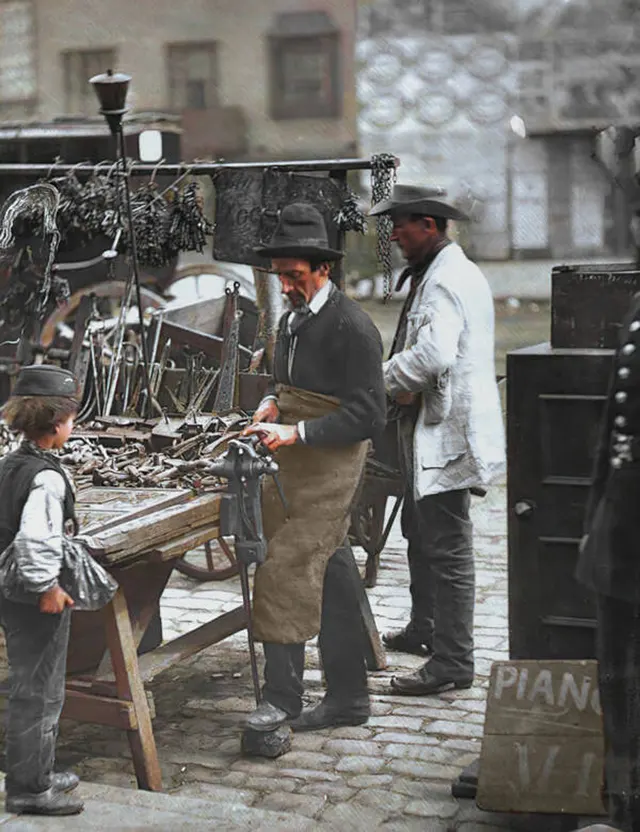
Leaning over a crowded workbench, the locksmith appears absorbed in the small, exacting labor of his trade, apron tied tight as his hands hover over clamps, files, and scattered bits of metal. The street stall is improvised but purposeful: tools hang within reach, and the tabletop becomes a miniature workshop set right on the cobblestones. In this colorized glimpse of the 1890s, the warm tones lend a lived-in immediacy to what might otherwise feel distant—work carried out in public, in full view of the street.
A child waits at the edge of the bench, watching the process with the quiet patience of someone used to errands that take time, while another man stands nearby as if waiting for a repair or a freshly cut key. The scene hints at a world where everyday security depended on skilled hands and a practiced eye, not factory uniformity. Street-side crafts like locksmithing served a constant stream of customers: jammed locks, worn keys, household hardware that needed coaxing back to life.
Behind the figures, the softened buildings and the open-air setting place the trade firmly in the rhythm of city life, where commerce, conversation, and craftsmanship mingled in the same space. For readers drawn to 19th-century work, urban history, and traditional hand tools, the photo offers a rich study in how artisans operated before modern shops and standardized parts became the norm. The colorization emphasizes texture—wood grain, metal sheen, dusty cloth—making the locksmith’s stall feel less like an artifact and more like a moment you can step into.