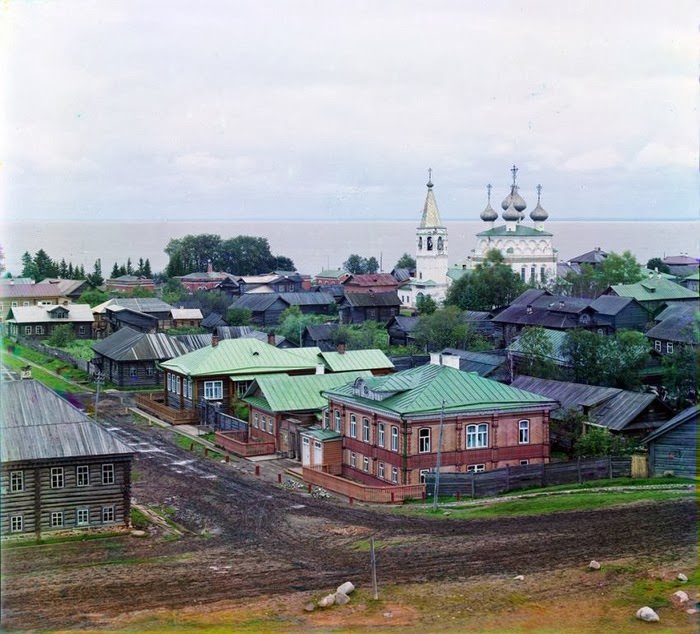
From the rampart, Beloyarsk spreads out in a layered panorama of low wooden roofs, garden plots, and broad, unpaved streets that look softened by recent rain. The colorization brings out the town’s muted palette—weathered timber, green metal roofing, and the earthy tones of a road that has been shaped as much by wheels and footsteps as by any formal plan. In the foreground, a more substantial brick-and-wood building anchors the view, hinting at local administration, trade, or a family of means within an otherwise modest streetscape.
Beyond the clustered houses, the church complex rises as the visual and symbolic center, its pale walls and onion domes standing above the treeline and rooftops. The contrast between the utilitarian geometry of the homes and the vertical accents of the bell tower and domes gives the scene a clear sense of hierarchy typical of many Russian provincial towns. Even without close-up detail, the skyline tells you where the community gathered, marked time, and oriented daily life.
As a general view dated 1909, the photograph offers a valuable record of Beloyarsk at the meeting point of tradition and gradual change, when wood remained the dominant material and open streets still defined the town’s rhythm. The rampart vantage point suggests an older defensive or administrative perimeter repurposed into a lookout, turning fortification into viewpoint. For readers interested in early 20th-century townscapes, Russian architecture, and the craft of photo colorization, this post invites a slow look at how settlement patterns, sacred buildings, and everyday infrastructure fit together in one carefully preserved moment.