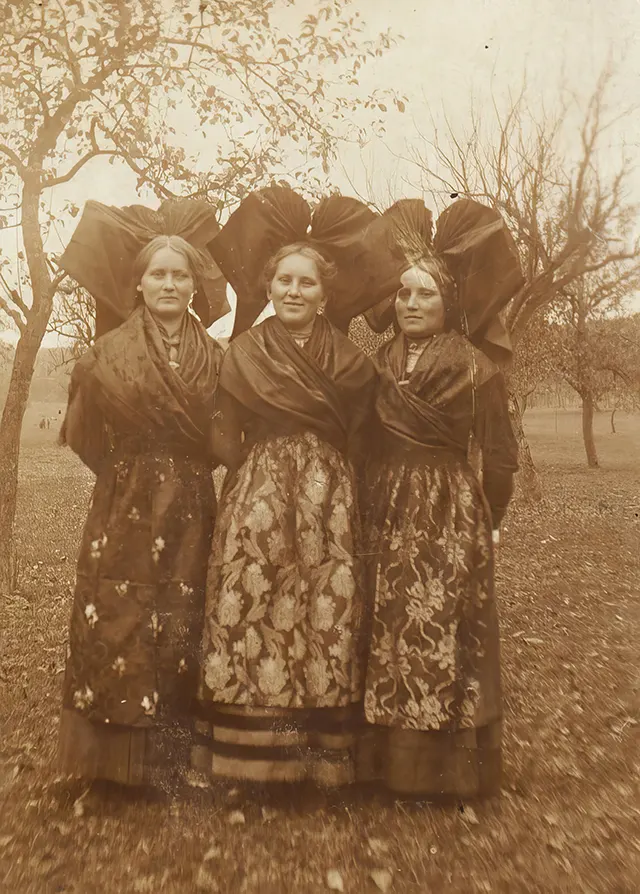
Three women stand shoulder to shoulder in an orchard-like landscape, their calm expressions and straight posture giving the portrait a quiet authority. Each wears the striking Schlupfkapp, its oversized, bow-like silhouette rising above the head and immediately commanding attention, while dark shawls are wrapped snugly across the chest. Beneath the shawls, patterned dresses—dense with floral motifs and heavy fabric—suggest both craftsmanship and practicality, the kind of everyday finery reserved for community gatherings and commemorative photographs.
In Alsace, traditional clothing has long functioned as a visual language, and the Schlupfkapp reads like a statement of belonging. The headwear frames the face and creates a strong outline that would have been instantly recognizable within local culture, distinguishing regional identity even when other fashions shifted with time. The careful layering—shawl, bodice, apron-like skirt—speaks to inherited custom, where textiles, stitching, and silhouette carried family pride as much as personal taste.
Behind them, bare branches and open ground set a rural backdrop that makes the garments feel even more deliberate, as if tradition is being held steady against a changing world. The photographer’s centered composition reinforces the sense of unity, turning three individual figures into a shared emblem of Alsatian heritage. For anyone searching for Alsace folk costume, Schlupfkapp history, or European regional fashion, this portrait offers a vivid, human-scale glimpse of how culture is worn, remembered, and passed on through generations.