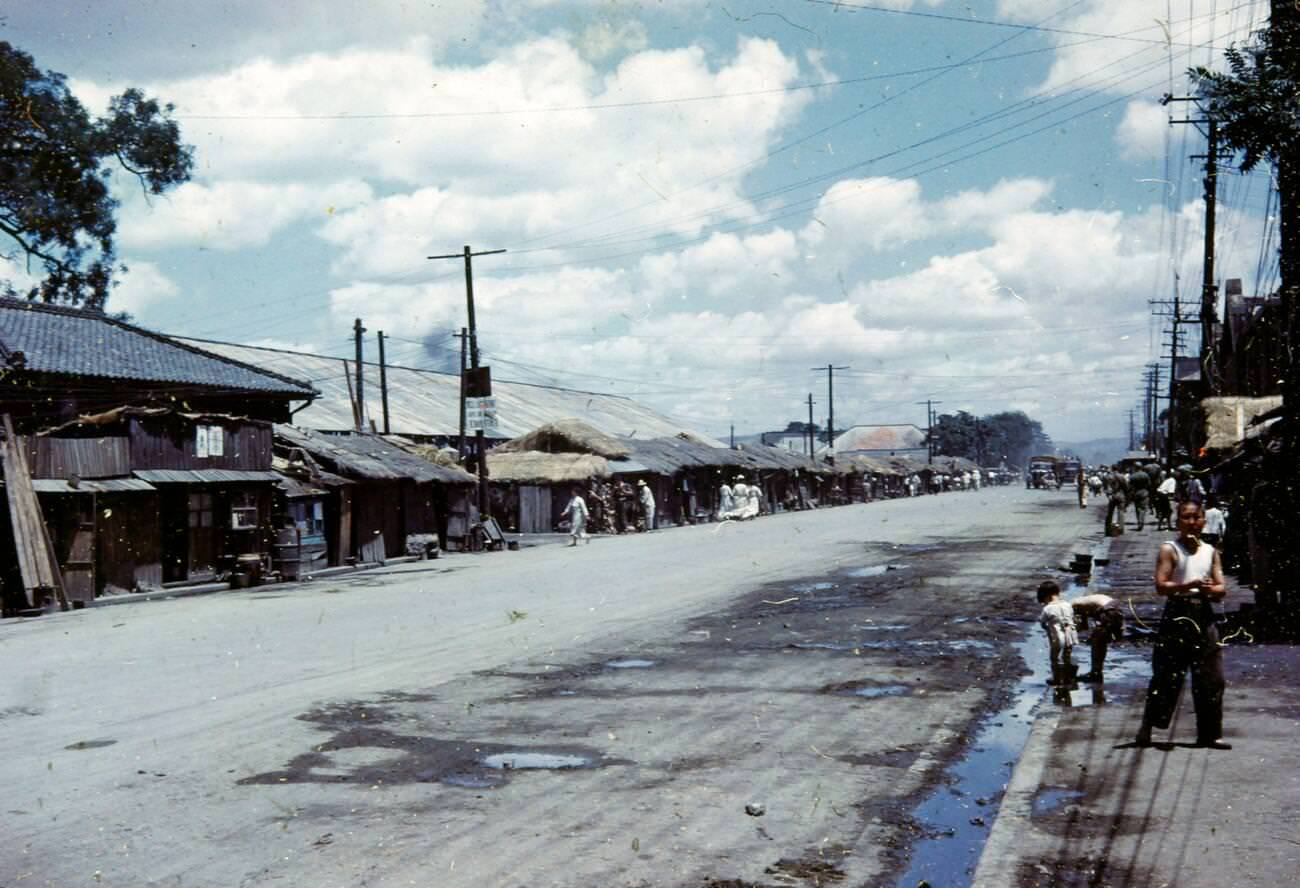
Under a wide summer sky, a long road in Taegu stretches past low, makeshift storefronts and thatched or patched roofs, their rough timbers and corrugated surfaces suggesting a city improvising in hard times. Utility poles and a web of wires march into the distance, guiding the eye toward small clusters of pedestrians and the faint outline of vehicles farther down the street. The scene is quiet rather than dramatic, yet the worn pavement and uneven edges hint at strain—an everyday streetscape shaped by disruption.
On the right edge of the frame, people linger near puddled water along the curb, a small, ordinary moment that feels especially poignant against the “Civil Wars” context of the post. The mix of traditional clothing and practical workwear, the open-front stalls, and the sparse traffic evoke the rhythms of a community trying to keep commerce and routine alive. Even without overt signs of battle, the atmosphere reads as provisional: spaces repurposed, resources stretched, life continuing between uncertainties.
Taegu, Korea, 1951 places this photograph squarely in the Korean War era, when the city became a crucial hub for civilians, refugees, and supply lines in the south. What makes the image compelling for historical readers is its plainness—the way it documents infrastructure, street-level trade, and the human scale of a wartime city without resorting to spectacle. For anyone searching for Taegu 1951, Korea 1950s street scenes, or Korean War home-front history, this frame offers a grounded, streetwise glimpse of survival and continuity.