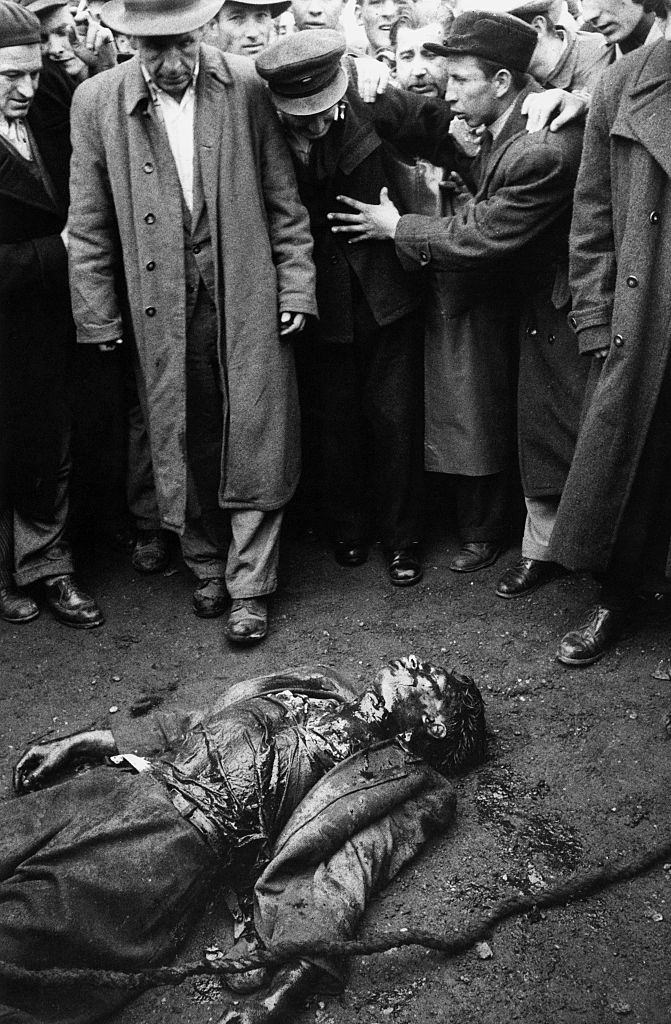
Tension gathers in a tight ring of faces as insurgents and onlookers lean inward, their coats and caps forming a human wall around what lies on the street. In the foreground rests the deceased body of a colonel of Hungary’s secret police (ÁVH), a grim focal point that draws every gaze downward. The scene is crowded yet hushed in feeling, the kind of moment when a city’s political struggle becomes abruptly intimate and impossible to ignore.
Budapest in November 1956 was a place where authority and revolt collided at street level, and the photograph holds that collision without relief. Men press close, some with hands on one another’s shoulders, as if steadying themselves amid shock, anger, or disbelief. The fallen uniformed figure—bloodied and motionless—speaks to the ferocity of the clashes and to the hated symbolism the secret police carried for many Hungarians during the uprising.
For readers searching for Hungarian Revolution 1956 photos, Budapest uprising images, or ÁVH history, this frame offers more than documentation—it conveys how quickly public space can turn into a tribunal of emotion. The crowd’s expressions, the cramped composition, and the stark contrast of street and body underline the brutal realities of civil conflict. It is an unflinching reminder that revolutions are not only fought in proclamations and barricades, but also witnessed in moments like this, where the consequences lie in plain view.