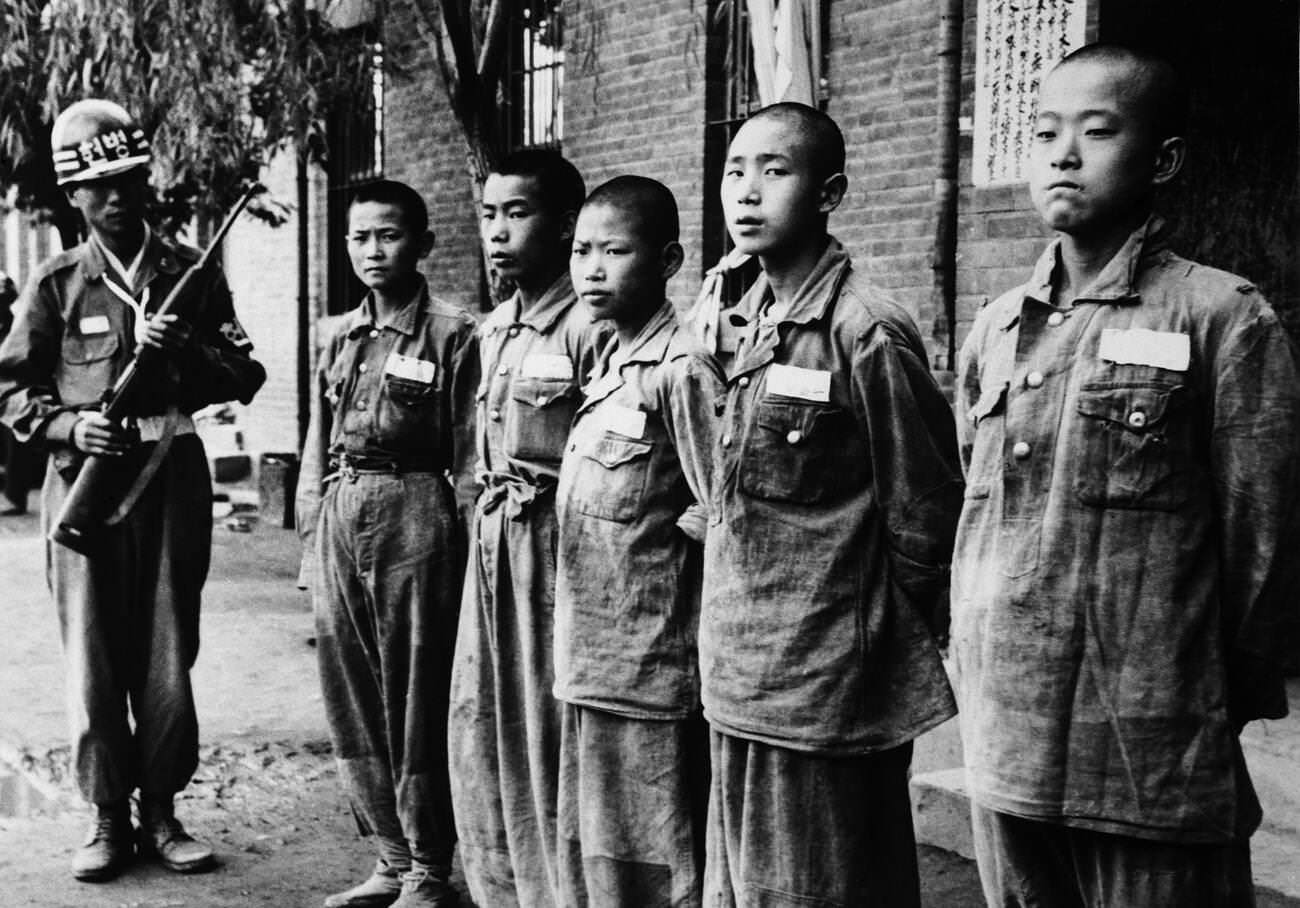
Along a brick wall, a line of young captives stands in rough uniforms, their heads closely shorn and their faces caught somewhere between defiance and exhaustion. Small identification tags pinned to their chests reduce individual lives to labels, while a guard at the edge of the frame grips a rifle and watches over the group. The stark composition, with bodies arranged in a tense row, turns the sidewalk into a makeshift holding space where ordinary youth is abruptly replaced by wartime status.
The title, “War – Korean War – The Young Captives, 1950s,” points to one of the conflict’s most haunting realities: prisoners were not always seasoned soldiers, and adolescence could be swept into the machinery of frontline decisions. Their clothing looks utilitarian and worn, suggesting hurried processing rather than ceremony, and the lack of personal belongings hints at how quickly capture stripped people down to the essentials. Even without a clearly stated location, the surrounding urban textures—brickwork, posted notices, and a narrow street—place this moment in a lived-in world where civilians and combatants were never far apart.
For readers exploring Korean War history through photography, this scene offers a powerful entry point into themes of detention, forced movement, and the human cost of civil conflict within a larger international war. The boys’ expressions invite the viewer to consider what came before the camera—recruitment, displacement, hunger, fear—and what uncertain future waited beyond the frame. As a historical photo, it preserves a difficult truth: in the 1950s Korean War, captivity could arrive early, and youth did not guarantee protection from the consequences of war.