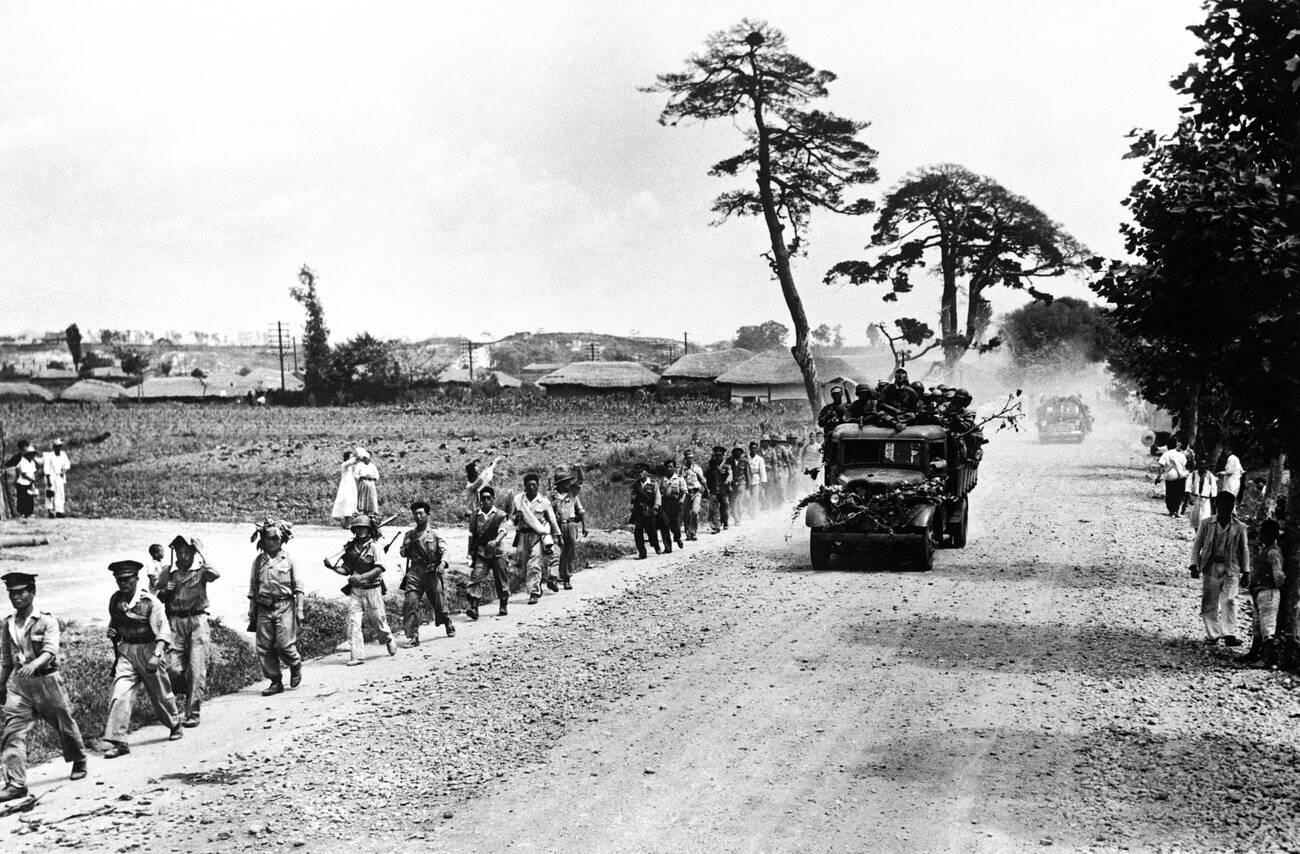
Dust hangs over a rough rural road as South Korean army troops push forward in a long column, some on foot with rifles and packs, others riding atop a military truck loaded with gear. Tall trees punctuate the roadside, while low, thatched-roof buildings sit back from the route, hinting at a countryside pulled into the orbit of war. The sense of motion is constant—boots on gravel, engines laboring, and the haze of the convoy drifting behind them.
Along the edges of the road, small clusters of civilians stand and watch, their stillness contrasting with the purposeful march toward the fighting zone. This quiet detail broadens the story beyond uniforms and vehicles, suggesting how conflict in the 1950s pressed into everyday life and turned ordinary paths into strategic corridors. The photograph’s wide view invites the eye to travel from the nearest soldiers to the receding trucks, following the line of movement into uncertainty.
As a historical wartime photo, it speaks to the logistics of mid-century combat as much as to battlefield drama: transport, discipline, and the steady accumulation of men and material moving toward danger. For readers searching Korean War-era imagery, South Korean military history, or 1950s conflict photography, the scene offers a grounded, human-scale perspective. The road, the villages, and the watching bystanders remind us that in civil wars and their aftermath, the front is never as distant as it seems.