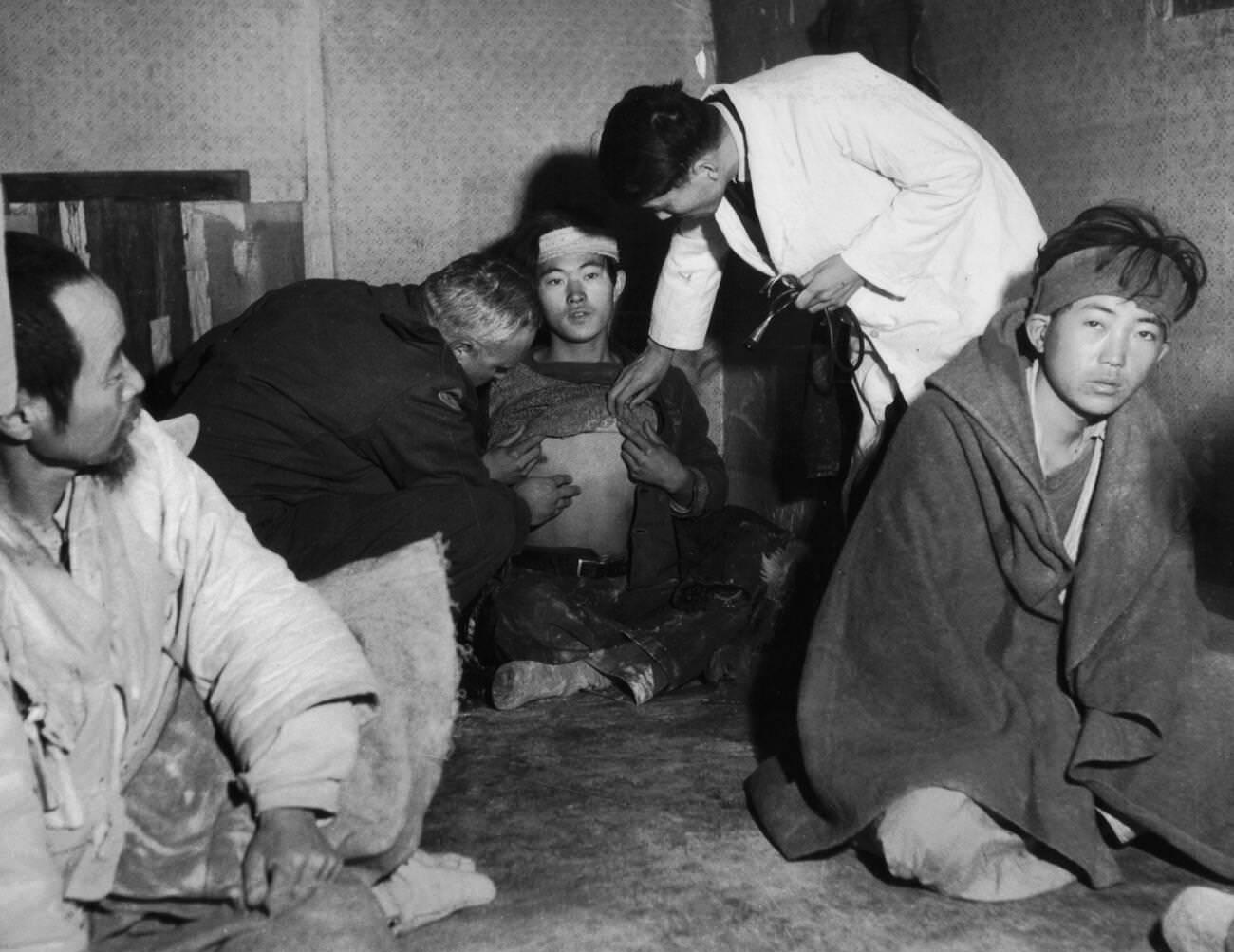
Inside a cramped shelter on Koje Island, the routines of survival give way to a tense medical examination. Doctor Henri Meyer leans in with a stethoscope as another attendant checks the young man’s body for signs of illness, his shirt lifted while he sits rigidly on a bare floor. Around them, other refugees wait in silence—wrapped in heavy blankets and bandages—watching a moment that could determine quarantine, treatment, or continued hardship.
The scene speaks to the fragile line between displacement and epidemic, especially when war pushes people into overcrowded camps with limited sanitation and supplies. Typhus, long associated with mass movement and scarcity, haunted such settings, turning simple symptoms into urgent threats to everyone nearby. In that atmosphere, the doctor’s careful listening becomes more than clinical work; it is a form of triage shaped by fear, fatigue, and the need to protect a community already under strain.
As a historical record, this 1951 photograph places public health at the center of a civil-war refugee story, showing how medicine operated in improvised rooms rather than modern hospitals. The patient’s steady gaze, the doctor’s white coat, and the stillness of the onlookers combine into a stark portrait of humanitarian crisis on Koje Island. For readers searching the history of refugees, camp life, and disease control, it offers a vivid reminder that conflict is measured not only in battles, but also in bodies examined one by one.