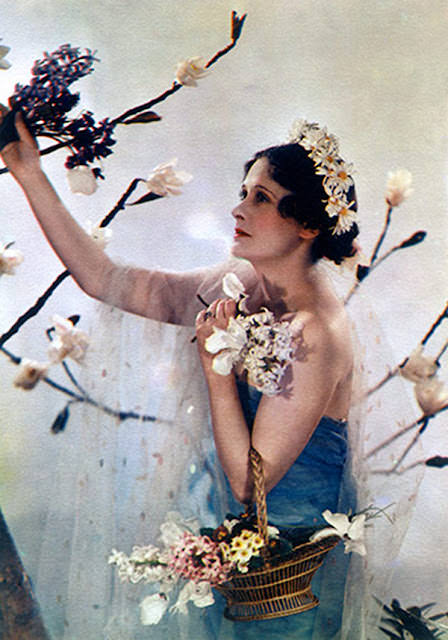
Lady Anne Rhys appears transformed into Flora, the Roman goddess of flowers, posed in a dreamy studio setting where pale blossoms float against a softly clouded backdrop. Her profile is turned upward as one arm reaches into the branchy spray of blooms, a gesture that reads like a blessing over springtime. A wreath of small white flowers crowns her dark, waved hair, and the whole composition leans into the theatrical grace of myth retold through portraiture.
Color plays a central role in the enchantment: a cool blue drape wraps her figure while a sheer veil spills behind her like mist, catching light and lending the scene an airy, almost painted quality. She cradles a cluster of flowers at her chest, and a wicker basket brimming with mixed blossoms anchors the lower frame, reinforcing Flora’s iconography as a bringer of abundance. The styling balances 1930s elegance with classical fantasy—more society portrait than archaeological costume—yet it convincingly conjures a goddess through texture, hue, and pose.
As part of Madame Yevonde’s celebrated “Goddesses” series, the photograph exemplifies how early color photography could be used to reinvent fashion, femininity, and myth in one arresting image. The meticulous staging—flowers arranged like a set design, the veil as atmospheric special effect—shows the era’s appetite for glamour and escapism, especially in portraits of aristocratic women adopting legendary roles. For viewers searching for Madame Yevonde, 1930s color portraiture, or Flora goddess imagery, this scene remains a striking example of how modern style and classical symbolism were fused into a single, luminous tableau.