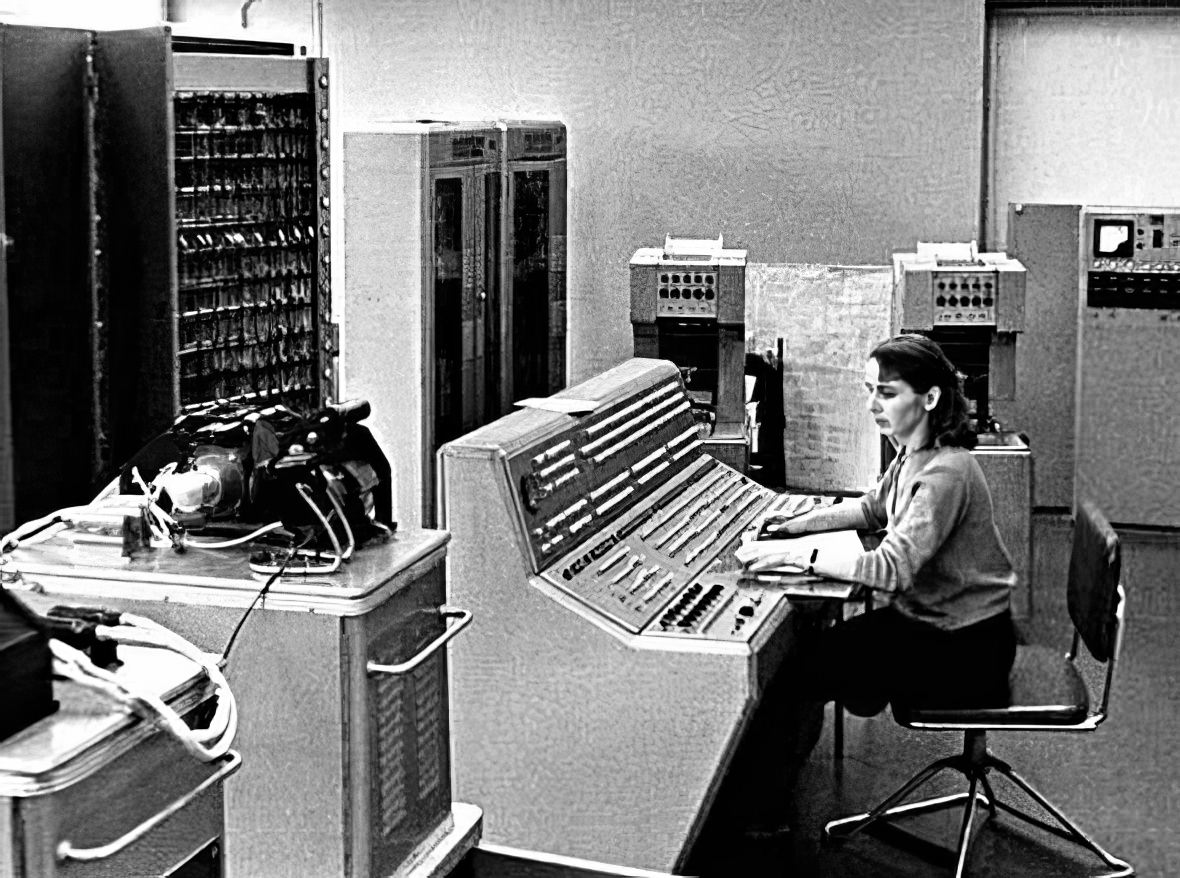
Inside a sparse laboratory, a wall of humming cabinets and exposed wiring frames an operator seated at a wide control console, hands poised among switches and indicator lights. The room feels engineered for focus: metal racks, instrument panels, and a work surface that suggests careful logging of results as much as machine operation. It’s the kind of environment where early computing wasn’t a desktop convenience but a disciplined partnership between people and hardware.
Latvia’s first computer, developed at the start-up Institute of Electronics and Computer Science in the early sixties, belonged to an era when progress looked like racks, relays, and meticulous monitoring. Rather than a single “box,” the computer appears as a system—multiple units performing separate roles, from processing to control and measurement—assembled through ingenuity, patience, and repeated testing. The photo hints at that formative moment when local engineering talent transformed theory into a working electronic machine.
Seen today, this historical image is more than an artifact of inventions; it’s a window into how computing began in Latvia and how much human labor stood behind every calculation. The console, the cabinets, and the attentive posture of the operator evoke the birth of a technological culture that would later shrink from room-sized equipment to everyday devices. For readers interested in Latvian technology history, early computer development, and the Institute of Electronics and Computer Science, the scene offers a grounded, compelling glimpse of the early-sixties computing world.