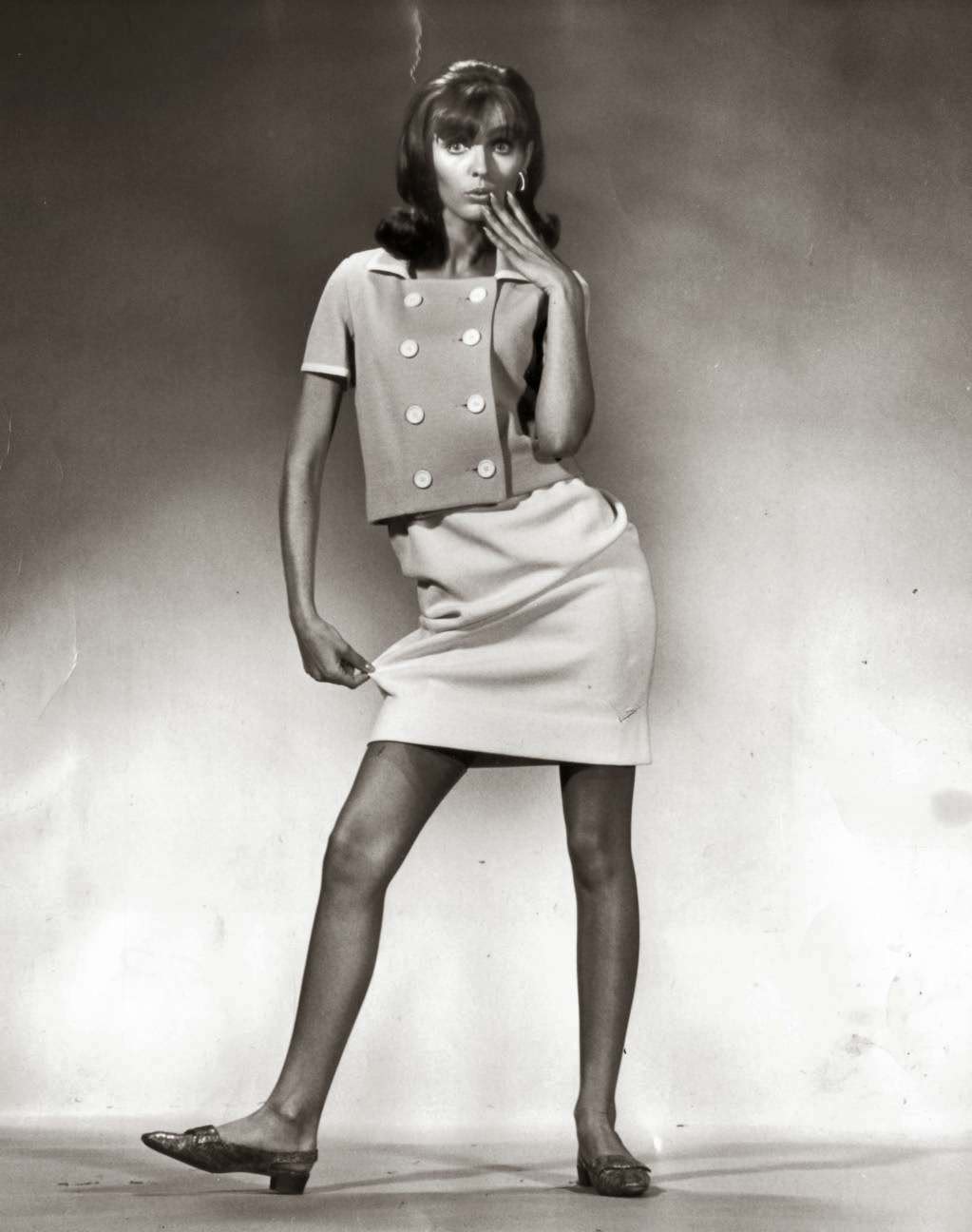
“Eight inches above the knee?” reads like a dare, and the Tribune archive photo dated June 18, 1965 answers with a wink. In a studio setting, a young woman poses with one hand lifted to her mouth and the other tugging lightly at the hem, as if inviting the viewer to judge just how far fashion can go. Her tailored, double-breasted top and sleek short skirt sit squarely in the mid-1960s moment when clean lines, youthful silhouettes, and a touch of provocation were reshaping everyday style.
The outfit’s sharp simplicity does most of the talking: large buttons, short sleeves, and a straight skirt that shows plenty of leg, paired with low-heeled flats that keep the look practical rather than costume-like. Lighting and composition emphasize the long vertical line from shoulder to shoe, turning what might have been “too short” into something modern, deliberate, and confidently worn. Even the subject’s expression—part surprise, part play—echoes the era’s mix of fascination and skepticism as hemlines climbed.
Fashion debates are never only about fabric, and the miniskirt’s rise became a shorthand for changing norms in youth culture, women’s autonomy, and what counted as respectable in public. This image works as both style documentation and social snapshot, capturing the moment when a few inches could spark headlines, dinner-table arguments, and a rush to the store. For readers searching mid-century fashion history, 1960s culture, or the story of the miniskirt, the photo stands as a crisp reminder of how quickly “unthinkable” can become mainstream.